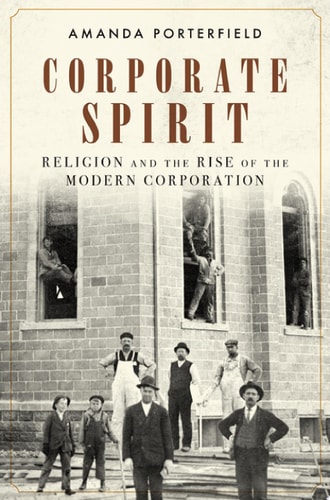
Corporate Spirit: Religion and the Rise of the Modern Corporation
0
0
As an Amazon Associate and affiliate partner, Menrva Books earns from qualifying purchases. Learn more
Author Description
In this groundbreaking work, Amanda Porterfield explores the long intertwining of religion and commerce in the history of incorporation in the United States. Beginning with the antecedents of that history in western Europe, she focuses on organizations to show how corporate strategies in religion and commerce developed symbiotically, and how religion has influenced the corporate structuring and commercial orientation of American society.Porterfield begins her story in ancient Rome. She traces the development of corporate organization through medieval Europe and Elizabethan England and then to colonial North America, where organizational practices derived from religion infiltrated commerce, and commerce led to political independence. Left more to their own devices than under British law, religious groups in the United States experienced unprecedented autonomy that facilitated new forms of communal governance and new means of broadcasting their messages. As commercial enterprise expanded, religious organizations grew apace, helping many Americans absorb the shocks of economic turbulence, and promoting new conceptions of faith, spirit, and will power that contributed to business.Porterfield highlights the role that American religious institutions played a society increasingly dominated by commercial incorporation and free market ideologies. She also shows how charitable impulses long nurtured by religion continued to stimulate reform and demand for accountability.
Menrva's Summary
THE THESIS
This work investigates the historical symbiosis between religious organizational structures and the development of the modern corporate entity in the United States. Amanda Porterfield, a scholar of American religious history, utilizes a broad historical framework to trace how corporate strategies evolved through the intersection of faith and commerce. By examining the transition from ancient Roman and medieval European models to the American colonial experience, she argues that religious autonomy and communal governance significantly shaped the trajectory of American commercial life and free-market ideologies.
THE SCOPE MAP
What You Will Find
- Historical analysis of corporate organization from ancient Rome through Elizabethan England to colonial North America.
- Examination of how religious groups utilized autonomy to develop new forms of communal governance and communication.
- Exploration of the influence of religious institutions on American economic turbulence and business culture.
- Analysis of the role of religious charitable impulses in fostering reform and corporate accountability.
THE AUTHORITY PERSPECTIVE
Scholars and historians recognize this text as a significant contribution to the study of American institutional development. Readers frequently note the academic rigor of the prose and the depth of the historical research provided by the author.
Page Count:
212
Publication Date:
2018-01-01
Publisher:
Oxford University Press
ISBN-10:
0199372675
ISBN-13:
9780199372676
Business
Religion
History
Economics
Business Aspects
Business Ethics
Corporations
Sociology
American History
Community Tags
Similar Books