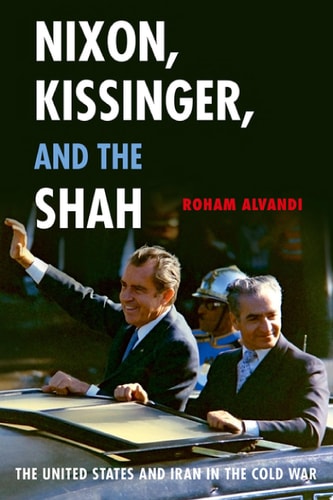
Nixon, Kissinger, and the Shah
0
0
As an Amazon Associate and affiliate partner, Menrva Books earns from qualifying purchases. Learn more
Author Description
Mohammad Reza Pahlavi, the last Shah of Iran, is often remembered as a pliant instrument of American power during the Cold War. In this study Roham Alvandi offers a revisionist account of the Shah's relationship with the United States by examining the partnership he forged with Richard Nixon and Henry Kissinger in the 1970s. Based on extensive research in the British and U.S. archives, as well as a wealth of Persian-language diaries, memoirs, and oral histories, this work restores agency to the Shah as an autonomous international actor and suggests that Iran evolved from a client to a partner of the United States under the Nixon Doctrine. Nixon, Kissinger, and the Shah offers a detailed account of three key historical episodes in the Nixon-Kissinger-Pahlavi partnership that shaped the global Cold War far beyond Iran's borders. It examines the emergence of Iranian primacy in the Persian Gulf as the Nixon administration looked to the Shah to fill the vacuum created by the British withdrawal from the region in 1971. It then turns to the peak of the partnership after Nixon and Kissinger's historic 1972 visit to Iran, when the Shah succeeded in drawing the United States into his covert war against Iraq in Kurdistan. Finally, it focuses on the decline of the partnership under Nixon's successor, Gerald Ford, through a history of the failed negotiations from 1974 to 1976 for an agreement on U.S. nuclear exports to Iran. Taken together, these episodes map the rise of the fall of Iran's Cold War partnership with the United States during the decade of superpower détente, Vietnam, and Watergate. This work of American diplomatic history, international relations, and Middle Eastern studies provides critical historic background on Iran's ambitions for primacy in the Persian Gulf, its nuclear program, and what a US-Iran strategic partnership might look like in the future.
Menrva's Summary
THE THESIS
This book investigates the complex diplomatic partnership between the Shah of Iran, Richard Nixon, and Henry Kissinger to determine if the Shah acted as a mere client or an autonomous international actor. Roham Alvandi, a historian specializing in modern Iranian history, utilizes a robust collection of primary sources including British and U.S. archives alongside Persian-language diaries and oral histories. He argues that the Nixon Doctrine facilitated a shift in the U.S.-Iran relationship, transforming Iran from a subordinate client state into a strategic partner with its own regional ambitions.
THE SCOPE MAP
What You Will Find
- Analysis of the power vacuum in the Persian Gulf following the 1971 British withdrawal.
- Documentation of the covert Iranian-led war against Iraq in Kurdistan.
- Examination of the failed 1974-1976 negotiations regarding U.S. nuclear exports to Iran.
- A historical framework evaluating the transition from the Nixon-Kissinger era to the Ford administration.
THE AUTHORITY PERSPECTIVE
Experts in diplomatic history and Middle Eastern studies frequently cite this work as a definitive account of the shifting power dynamics during the 1970s. Readers often note the academic density of the prose, which provides a rigorous and well-supported challenge to traditional narratives regarding the Shah's agency.
Page Count:
272
Publication Date:
2014-01-01
Publisher:
Oxford University Press
ISBN-10:
0199375704
ISBN-13:
9780199375707
History
Biography
International relations
Cold War
Community Tags
Similar Books