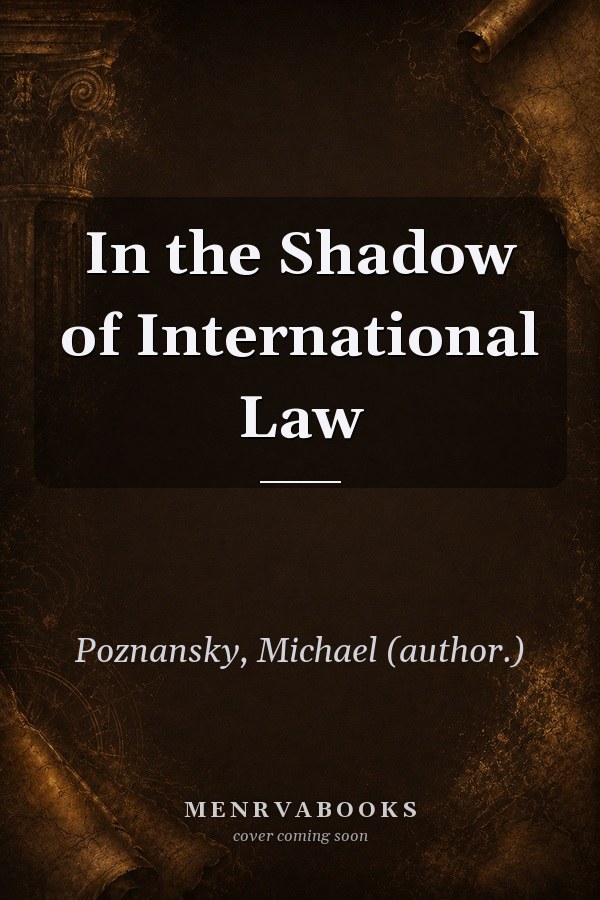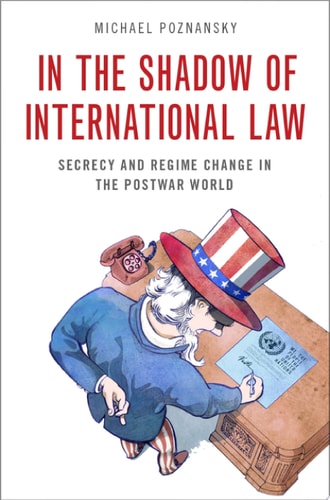
In the Shadow of International Law: Secrecy and Regime Change in the Postwar World
0
0
As an Amazon Associate and affiliate partner, Menrva Books earns from qualifying purchases. Learn more
Author Description
Secrecy is a staple of world politics and a pervasive feature of political life. Leaders keep secrets as they conduct sensitive diplomatic missions, convince reluctant publics to throw their support behind costly wars, and collect sensitive intelligence about sworn enemies.In the Shadow of International Law explores one of the most controversial forms of secret statecraft: the use of covert action to change or overthrow foreign regimes. Drawing from a broad range of cases of US-backed regime change during the Cold War, Michael Poznansky develops a legal theory of covert action to explain why leaders sometimes turn to covert action when conducting regime change, rather than using force to accomplish the same objective. He highlights the surprising role international law plays in these decisions and finds that once the nonintervention principle-which proscribes unwanted violations of another state's sovereignty-was codified in international law in the mid-twentieth century, states became more reluctant to pursue overt regime change without proper cause. Further, absent a legal exemption to nonintervention such as a credible self-defense claim or authorization from an international body, states were more likely to pursue regime change covertly and concealing brazen violations of international law.Shining a light on the secret underpinnings of the liberal international order, the conduct of foreign-imposed regime change, and the impact of international law on state behavior, Poznansky speaks to the potential consequences of America abandoning its role as the steward of the postwar order, as well as the promise and peril of promoting new rules and norms in cyberspace.
Menrva's Summary
THE THESIS
This book investigates why states utilize covert action rather than overt force when seeking to overthrow foreign regimes. Michael Poznansky, a scholar of international relations, utilizes a legal theory framework to analyze US-backed regime change operations during the Cold War. He argues that the codification of the nonintervention principle in the mid-twentieth century created a legal constraint that incentivized states to hide violations of sovereignty behind a veil of secrecy.
THE SCOPE MAP
What You Will Find
- A legal theory of covert action regarding regime change
- Analysis of the nonintervention principle in international law
- Examination of US foreign policy during the Cold War
- Discussion on the future of norms in cyberspace
Scope Limits
- The study focuses primarily on US-backed operations
- It does not provide an exhaustive history of all global regime changes
THE AUTHORITY PERSPECTIVE
Experts identify this work as a significant contribution to the study of statecraft and the intersection of international law and clandestine operations. Readers frequently note the academic rigor of the prose and the clarity of the author's theoretical framework.
Page Count:
257
Publication Date:
2020-01-01
Publisher:
Oxford University Press
ISBN-10:
0190096616
ISBN-13:
9780190096618
History
Cold War
Professional Career & Trade
Subversive Activities
Regime Change
Sovereignty Violation Of
International Security
International relations
Foreign Policy
International Law
Espionage
Community Tags
Similar Books