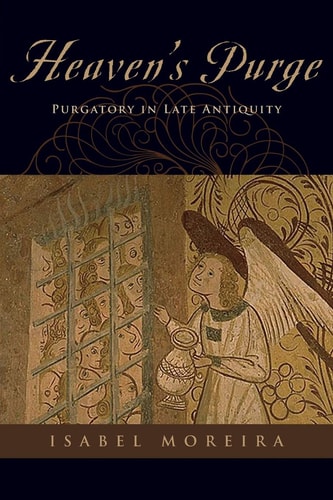
Heaven's Purge: Purgatory in Late Antiquity
0
0
As an Amazon Associate and affiliate partner, Menrva Books earns from qualifying purchases. Learn more
Author Description
The doctrine of purgatory - the state after death in which Christians undergo punishment by God for unforgiven sins - raises many questions. What is purgatory like? Who experiences it? Does purgatory purify souls, or punish them, or both? How painful is it? Heaven's Purge explores the first posing of these questions in Christianity's early history, from the first century to the eighth: an era in which the notion that sinful Christians might improve their lot after death was contentious, or even heretical.Isabel Moreira discusses a wide range of influences at play in purgatory's early formation, including ideas about punishment and correction in the Roman world, slavery, the value of medical purges at the shrines of saints, and the authority of visions of the afterlife for informing Christians of the hereafter. She also challenges the deeply ingrained supposition that belief in purgatory was a symptom of barbarized Christianity, and assesses the extent to which Irish and Germanic views of society, and the sources associated with them - penitentials and legal tariffs - played a role in purgatory's formation. Special attention is given to the writings of the last patristic author of antiquity, the Northumbrian monk Bede.Heaven's Purge is the first study to focus on purgatory's history in late antiquity, challenging the conclusions of recent scholarship through an examination of the texts, communities and cultural ideas that informed purgatory's early history.
Menrva's Summary
THE THESIS
This book investigates the historical origins and theological development of the doctrine of purgatory within early Christianity, specifically between the first and eighth centuries. Isabel Moreira, a scholar of early medieval history, utilizes a diverse array of primary sources, including penitentials, legal texts, and hagiographic accounts, to reconstruct how early Christians conceptualized post-mortem purification. She argues that the formation of purgatory was not a sign of cultural decline but a complex synthesis of Roman legal concepts, medical metaphors, and regional social structures.
THE SCOPE MAP
What You Will Find
- Analysis of the transition from early Christian eschatological uncertainty to defined purgatorial doctrine.
- Examination of the influence of Roman slavery and judicial punishment on afterlife imagery.
- Investigation into the role of Irish and Germanic legal tariffs in shaping penitential practices.
- Detailed study of the writings of the Northumbrian monk Bede as a culmination of patristic thought.
THE AUTHORITY PERSPECTIVE
Scholars recognize this work as a significant contribution to the study of early medieval eschatology and the cultural history of the afterlife. Readers frequently note the academic density of the prose and the author's rigorous engagement with both Latin texts and historical context.
Page Count:
328
Publication Date:
2014-05-01
Publisher:
Oxford University Press
ISBN-10:
0199375011
ISBN-13:
9780199375011
History
Religion
Purgatory
Late Antiquity
Christianity
Theology
Community Tags
Similar Books