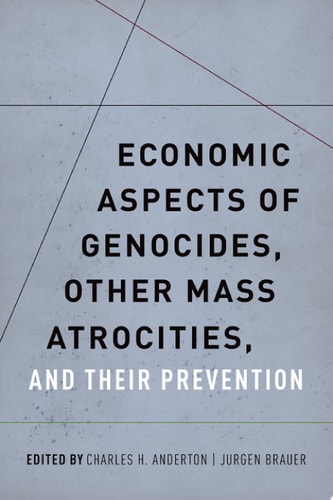
Economic Aspects of Genocides, Other Mass Atrocities, and Their Prevention
0
0
As an Amazon Associate and affiliate partner, Menrva Books earns from qualifying purchases. Learn more
Author Description
Alongside other types of mass atrocities, genocide has received extensive scholarly, policy, and practitioner attention. Missing, however, is the contribution of economists to better understand and prevent such crimes. This edited collection by 41 accomplished scholars examines economic aspects of genocides, other mass atrocities, and their prevention.Chapters include numerous case studies (e.g., California's Yana people, Australia's Aborigines peoples, Stalin's killing of Ukrainians, Belarus, the Holocaust, Rwanda, DR Congo, Indonesia, Pakistan, Colombia, Mexico's drug wars, and the targeting of suspects during the Vietnam war), probing literature reviews, and completely novel work based on extraordinary country-specific datasets. Also included are chapters on the demographic, gendered, and economic class nature of genocide. Replete with research- and policy-relevant findings, new insights are derived from behavioral economics, law and economics, political economy, macroeconomic modeling, microeconomics, development economics, industrial organization, identity economics, and other fields. Analytical approaches include constrained optimization theory, game theory, and sophisticated statistical work in data-mining, econometrics, and forecasting.A foremost finding of the book concerns atrocity architects' purposeful, strategic use of violence, often manipulating nonrational proclivities among ordinary people to sway their participation in mass murder. Relatively understudied in the literature, the book also analyzes the options of victims before, during, and after mass violence. Further, the book shows how well-intended prevention efforts can backfire and increase violence, how wrong post-genocide design can entrench vested interests to reinforce exclusion of vulnerable peoples, and how businesses can become complicit in genocide. In addition to the necessity of healthy opportunities in employment, education, and key sectors in prevention work, the book shows why new
Menrva's Summary
THE THESIS
This volume investigates the intersection of economic theory and the perpetration of genocide, seeking to identify how economic incentives, structures, and behaviors contribute to mass atrocities. Editors Charles H. Anderton and Jurgen Brauer compile contributions from 41 scholars to bridge the gap between economic analysis and genocide studies. By applying frameworks such as game theory, behavioral economics, and econometrics, the authors argue that mass violence is often a strategic, purposeful endeavor rather than a purely chaotic event. The work provides a rigorous analytical foundation for understanding the economic drivers of violence and the complexities of prevention.
THE SCOPE MAP
What You Will Find
- Case studies covering diverse historical contexts including the Holocaust, Rwanda, the DR Congo, and the Yana people of California.
- Applications of economic methodologies such as constrained optimization, industrial organization, and identity economics.
- Analysis of the strategic role of atrocity architects and the decision-making options available to victims.
- Evaluations of how international prevention efforts can inadvertently exacerbate violence or entrench exclusionary systems.
THE AUTHORITY PERSPECTIVE
Experts recognize this collection as a significant contribution to the field of peace and conflict studies by introducing formal economic modeling to a subject traditionally dominated by sociology and political science. Readers frequently note the academic density of the prose, which requires a foundational understanding of economic theory to fully grasp the statistical and game-theoretic arguments presented.
Page Count:
728
Publication Date:
2016-06-06
Publisher:
Oxford University Press
ISBN-10:
0199378290
ISBN-13:
9780199378296
Economics
History
Public Policy
Sociology
Genocide
Atrocities
Human rights
Community Tags
Other Editions(2)
Similar Books







Reader Comments
Share Your Thoughts
No comments yet. Be the first to share your thoughts!