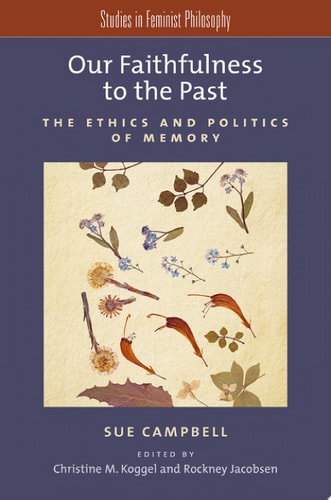
Our Faithfulness to the Past: The Ethics and Politics of Memory
0
0
As an Amazon Associate and affiliate partner, Menrva Books earns from qualifying purchases. Learn more
Author Description
This volume brings together essays -- three of them previously unpublished -- on the epistemology, ethics, and politics of memory by the late feminist philosopher Sue Campbell. The essays in Part I diagnose contemporary skepticism about personal memory, and develop an account of good remembering that is better suited to contemporary (reconstructive) theories of memory. Campbell argues that being faithful to the past requires both accuracy and integrity, and is both an epistemic and an ethical achievement. The essays in Part II focus on the activities and practices through which we explore and negotiate the shared significance of our different recollections of the past, and the importance of sharing memory for constituting our identities. Views about self, identity, relation, and responsibility (all influenced by traditions in feminist philosophy) are examined through the lens of Campbell's relational conception of memory. She argues that remaining faithful to our past sometimes requires us to re-negotiate the boundaries between ourselves and the collectives to which we belong. In Part III, Campbell uses her relational theory of memory to address the challenges of sharing memory and renewing selves in contexts that are fractured by moral and political difference, especially those arising from a history of injustice and oppression. She engages in detail Canada's Indian Residential Schools Truth and Reconciliation Commission, where survivor memories have the potential to illuminate the significance of the past for a shared future. The study of memory brings together philosophers, psychologists, historians, anthropologists, legal theorists, and political theorists and activists. Sue Campbell demonstrates a singular ability to put these many different areas of scholarship and activism into fruitful conversation with each other while also adding an original and powerful voice to the discussion.
Menrva's Summary
THE THESIS
How can individuals and collectives maintain ethical integrity when navigating the reconstructive nature of memory in the wake of historical injustice? Sue Campbell, a noted feminist philosopher, utilizes a relational framework to examine memory not merely as a cognitive retrieval process, but as an epistemic and ethical practice. By synthesizing perspectives from psychology, history, and political theory, she argues that our capacity to remain faithful to the past is essential for identity formation and the resolution of systemic moral fractures.
THE SCOPE MAP
What You Will Find
- A relational theory of memory that emphasizes the social and political dimensions of recollection.
- Analysis of the tension between accuracy and integrity in personal and collective memory.
- Case study examination of Canada's Indian Residential Schools Truth and Reconciliation Commission.
- Theoretical exploration of how shared memory facilitates identity negotiation within fractured political contexts.
THE AUTHORITY PERSPECTIVE
Scholars in the field of memory studies and feminist philosophy recognize this collection as a significant contribution to the intersection of ethics and epistemology. Experts frequently highlight Campbell's ability to bridge abstract philosophical inquiry with the practical, often difficult, realities of political reconciliation and historical trauma.
Page Count:
248
Publication Date:
2014-08-01
Publisher:
Oxford University Press
ISBN-10:
019937693X
ISBN-13:
9780199376933
Philosophy
Social Theory
Ethics
Memory Studies
Feminist Theory
Womens Studies
Memory
Feminist Philosophy
Community Tags
Similar Books