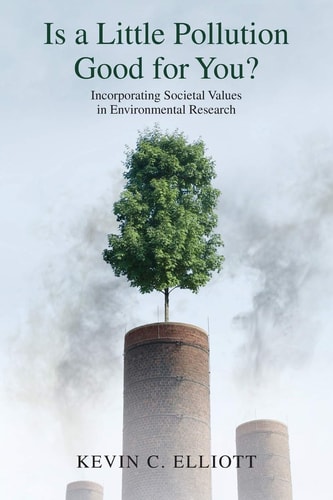
Is a Little Pollution Good for You?: Incorporating Societal Values in Environmental Research
0
0
As an Amazon Associate and affiliate partner, Menrva Books earns from qualifying purchases. Learn more
Author Description
Could low-level exposure to polluting chemicals be analogous to exercise -- a beneficial source of stress that strengthens the body? Some scientists studying the phenomenon of hormesis (beneficial or stimulatory effects caused by low-dose exposure to toxic substances) claim that that this may be the case. Is A Little Pollution Good For You? critically examines the current evidence for hormesis. In the process, it highlights the range of methodological and interpretive judgments involved in environmental research: choices about what questions to ask and how to study them, decisions about how to categorize and describe new information, judgments about how to interpret and evaluate ambiguous evidence, and questions about how to formulate public policy in response to debated scientific findings. The book also uncovers the ways that interest groups with deep pockets attempt to influence these scientific judgments for their benefit. Several chapters suggest ways to counter these influences and incorporate a broader array of societal values in environmental research: (1) moving beyond conflict-of-interest policies to develop new ways of safeguarding academic research from potential biases; (2) creating deliberative forums in which multiple stakeholders can discuss the judgments involved in policy-relevant research; and (3) developing ethical guidelines that can assist scientific experts in disseminating debated and controversial phenomena to the public. Kevin C. Elliott illustrates these strategies in the hormesis case, as well as in two additional case studies involving contemporary environmental research: endocrine disruption and multiple chemical sensitivity. This book should be of interest to a wide variety of readers, including scientists, philosophers, policy makers, environmental ethicists and activists, research ethicists, industry leaders, and concerned citizens.
Menrva's Summary
THE THESIS
Does the scientific phenomenon of hormesis—the potential for low-dose exposure to toxins to provide beneficial effects—reveal the inherent influence of societal values on environmental research? Kevin C. Elliott, a professor of philosophy and science policy, utilizes the debate surrounding hormesis to investigate how methodological choices, interpretive judgments, and external interest groups shape scientific consensus. He argues that because environmental research is rarely value-neutral, the scientific community must adopt more robust ethical frameworks to safeguard the integrity of policy-relevant data.
THE SCOPE MAP
What You Will Find
- An analysis of the hormesis hypothesis and its implications for toxicology and public health.
- Case studies on endocrine disruption and multiple chemical sensitivity as examples of debated environmental research.
- Methodological strategies for identifying and mitigating bias in academic and industry-funded studies.
- Proposals for deliberative forums and ethical guidelines to incorporate diverse societal values into policy formulation.
THE AUTHORITY PERSPECTIVE
Experts in science policy and environmental ethics recognize this work as a significant contribution to the study of how values influence scientific inquiry. Readers frequently note the clarity with which the author navigates complex intersections of technical toxicology and philosophical analysis.
Page Count:
264
Publication Date:
2014-05-01
Publisher:
Oxford University Press
ISBN-10:
0199374066
ISBN-13:
9780199374069
Public Health
Science Policy
Pollution
Community Tags
Other Editions(3)
Similar Books



Reader Comments
Share Your Thoughts
No comments yet. Be the first to share your thoughts!