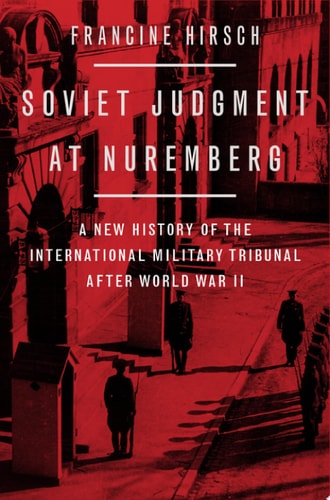
Soviet Judgment at Nuremberg: A New History of the International Military Tribunal after World War II
0
0
As an Amazon Associate and affiliate partner, Menrva Books earns from qualifying purchases. Learn more
Author Description
Organized in the immediate aftermath of World War Two by the victorious Allies, the Nuremberg Trials were intended to hold the Nazis to account for their crimes — and to restore a sense of justice to a world devastated by violence. As Francine Hirsch reveals in this immersive, gripping, and ground-breaking book, a major piece of the Nuremberg story has routinely been omitted from standard accounts: the part the Soviet Union played in making the trials happen in the first place. Soviet Judgment at Nuremberg offers the first complete picture of the International Military Tribunal (IMT), including the many ironies brought to bear as the Soviets took their place among the countries of the prosecution in late 1945. Everyone knew that Stalin had allied with Hitler before the Nazi invasion of the Soviet Union in 1941. The Molotov-Ribbentrop Pact hung heavy over the courtroom, as did the suspicion that the Soviets had falsified evidence in an attempt to pin one of their own war crimes, the mass killing of Polish officers in the Katyn Forest, on the Nazis. Moreover, key members of the Soviet delegation, including the Soviet judge and chief prosecutor, had played critical roles in Stalin's infamous show trials of the 1930s. For the American prosecutor Robert H. Jackson and his colleagues in the British and French delegations, Soviet participation in the IMT undermined the credibility of the trials and indeed the moral righteousness of the Allied victory.Yet without the Soviets Nuremberg would never have taken place. Soviet jurists conceived of the legal framework that treated war as an international crime, giving the trials a legal basis. The Soviets had borne the brunt of the fighting against Germany, and their almost unimaginable suffering gave them moral authority. They would not be denied a place on the tribunal and moreover were determined to make the most of it. However, little went as the Soviets had planned. Stalin's efforts to steer the trials from afar backfired. So
Menrva's Summary
THE THESIS
This book investigates the critical, often overlooked role of the Soviet Union in the formation and execution of the International Military Tribunal at Nuremberg. Francine Hirsch, a historian specializing in Russian and Soviet history, utilizes extensive archival research from both Western and Soviet sources to reconstruct the complex diplomatic and legal negotiations that defined the trials. She argues that while Soviet participation was essential to the legal framework of the proceedings, it simultaneously introduced profound moral and political contradictions that challenged the Allied prosecution's narrative of justice.
THE SCOPE MAP
What You Will Find
- Detailed analysis of the legal framework developed by Soviet jurists regarding crimes against peace.
- Examination of the tension between the Allied powers and the Soviet delegation regarding the Katyn Forest massacre.
- Primary source evidence from Soviet archives detailing Stalin's attempts to influence the tribunal proceedings.
- Contextual history of the Soviet prosecutors and judges who transitioned from the 1930s show trials to the Nuremberg courtroom.
THE AUTHORITY PERSPECTIVE
Experts recognize this work as a significant contribution to the historiography of the Nuremberg Trials, specifically for its integration of previously inaccessible Soviet perspectives. Readers frequently note the academic rigor and the clarity with which the author navigates the complex geopolitical tensions of the post-war era.
Page Count:
553
Publication Date:
2020-01-01
Publisher:
Oxford University Press
ISBN-10:
0199377952
ISBN-13:
9780199377954
Biography
History
Jewish History
International Law
Modern History
Legal History
Criminal Law
Soviet Union
European History
Community Tags
Similar Books



Reader Comments
Share Your Thoughts
No comments yet. Be the first to share your thoughts!