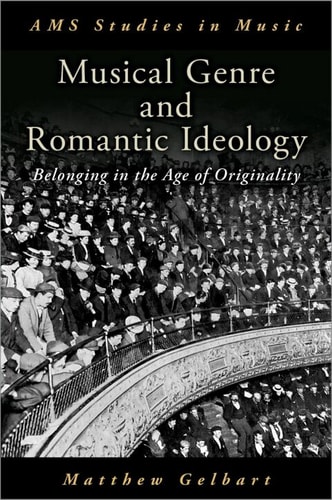
Musical Genre and Romantic Ideology: Belonging in the Age of Originality
0
0
As an Amazon Associate and affiliate partner, Menrva Books earns from qualifying purchases. Learn more
Author Description
European Romanticism gave rise to a powerful discourse equating genres to constrictive rules and forms that great art should transcend; and yet without the categories and intertextual references we hold in our minds, "music" would be meaningless noise. Musical Genre and Romantic Ideology teases out that paradox, charting the workings and legacies of Romantic artistic values such as originality and anti-commercialism in relation to musical genre. Genre's persistent power was amplified by music's inevitably practical social, spatial, and institutional frames. Furthermore, starting in the nineteenth century, all music, even the most anti-commercial, was stamped by its relationship to the marketplace, entrenching associations between genres and target publics (whether based on ideas of nation, gender, class, or more subtle aspects of identity). These newly strengthened correlations made genre, if anything, more potent rather than less, despite Romantic claims.In case studies from across nineteenth-century Europe engaging with canonical music by Bizet, Chopin, Verdi, Wagner, and Brahms, alongside representative genres such as opéra-comique and the piano ballade, Matthew Gelbart explores the processes through which composers, performers, critics, and listeners gave sounds, and themselves, a sense of belonging. He examines genre vocabulary and discourse, the force of generic titles, how avant-garde music is absorbed through and into familiar categories, and how interpretation can be bolstered or undercut by genre agreements. Even in a modern world where transcription and sound recording can take any music into an infinite array of new spatial and social situations, we are still locked in the Romantics' ambivalent tussle with genre.
Menrva's Summary
THE THESIS
This book investigates the paradox of how the Romantic ideal of artistic originality coexists with the persistent, necessary reliance on musical genres to provide meaning and social context. Matthew Gelbart, a scholar of musicology, utilizes historical analysis and music theory to argue that despite Romanticism's rejection of rigid forms, genre became increasingly potent as a tool for defining identity, class, and market position throughout the nineteenth century. He demonstrates that the tension between the desire for individual expression and the structural requirements of genre remains a defining feature of modern musical consumption.
THE SCOPE MAP
What You Will Find
- Analysis of nineteenth-century European musical discourse and aesthetic values.
- Examination of the relationship between anti-commercialism and the music marketplace.
- Case studies focusing on composers including Bizet, Chopin, Verdi, Wagner, and Brahms.
- Exploration of specific genres such as opéra-comique and the piano ballade.
Scope Limits
- The text does not provide an exhaustive history of all musical genres.
- The analysis is primarily focused on European classical traditions rather than global or non-Western musical systems.
THE AUTHORITY PERSPECTIVE
Scholars and music historians frequently cite this work as a rigorous examination of the intersection between aesthetic philosophy and social practice. Readers note the academic density of the prose, which serves as a foundational text for understanding how genre functions as a mechanism for social and cultural belonging.
Page Count:
552
Publication Date:
2022-01-01
Publisher:
Oxford University Press
ISBN-10:
0190646942
ISBN-13:
9780190646943
History
Criticism history
Musicology
Music History
Music theory
Sociology of Music
Romanticism
European History
Europe
Humanities
Cultural History
Community Tags
Similar Books