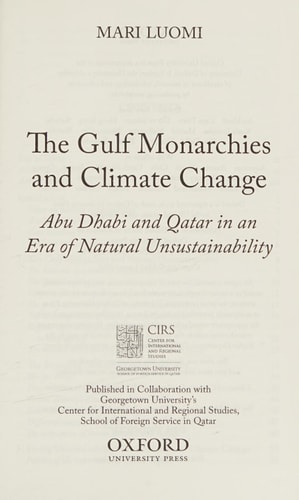
The Gulf Monarchies and Climate Change: Abu Dhabi and Qatar in an Era of Natural Unsustainability
0
0
As an Amazon Associate and affiliate partner, Menrva Books earns from qualifying purchases. Learn more
Author Description
At the heart of Mari Luomi's salutary book is whether oil- and gas-dependent authoritarian monarchies can keep their natural resource use and the environment in balance. She argues that the Gulf monarchies have already reached their limits of 'natural sustainability', given that several of them are dependent on natural gas imports. Water resources are dwindling, and food import dependence is high and rising. Qatar's per capita emission of CO2 is ten times the global average. As a result of their booming economies, the Gulf monarchies' surging electricity and water demand have exerted unexpected pressures on domestic energy supply. Simultaneously, the consolidation of climate change on the international agenda has created a new uncertainty for local rulers whose survival depends on sales of oil and gas. Meanwhile domestic resource consumption, together with climate change, are putting unprecedented stress on the region's fragile desert environment. The Gulf is under stress, but so too are its states' power, wealth and ecosystems. Luomi reveals how Abu Dhabi and Qatar have responded to these new natural re- source-related pressures, particularly climate change, and how their responses are inextricably linked with elite legitimacy strategies and the 'natural unsustainability' of their political economies.
Menrva's Summary
THE THESIS
Can oil- and gas-dependent authoritarian monarchies reconcile their economic models with the physical limits of natural resource sustainability? Mari Luomi, an expert in Middle Eastern environmental politics, investigates the intersection of climate change, resource scarcity, and political legitimacy in the Gulf. By analyzing the specific cases of Abu Dhabi and Qatar, she argues that the reliance on fossil fuel exports creates a paradox where domestic consumption and international climate agendas threaten the long-term stability of these regimes.
THE SCOPE MAP
What You Will Find
- Comparative analysis of environmental policy in Abu Dhabi and Qatar
- Examination of water scarcity and food import dependency in desert ecosystems
- Assessment of the impact of high per capita CO2 emissions on state legitimacy
- Evaluation of how domestic energy demand pressures the political economy of oil-exporting states
THE AUTHORITY PERSPECTIVE
Scholars and policy analysts recognize this work as a critical contribution to understanding the intersection of petro-politics and environmental sustainability in the Gulf. The text is noted for its rigorous academic approach and its ability to connect local resource management challenges with broader global climate policy frameworks.
Page Count:
301
Publication Date:
2014-12-15
Publisher:
Oxford University Press
ISBN-10:
0199387524
ISBN-13:
9780199387526
Energy policy
Oil Industries
United Arab Emirates
Qatar
Climate Change
Climatic changes
Arab Countries
Community Tags
Similar Books