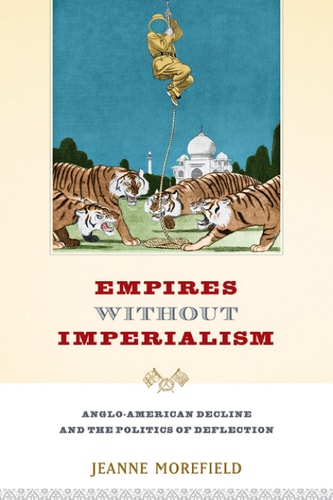
Empires Without Imperialism: Anglo-American Decline and the Politics of Deflection
0
0
As an Amazon Associate and affiliate partner, Menrva Books earns from qualifying purchases. Learn more
Author Description
The end of the Cold War ushered in a moment of nearly pure American dominance on the world stage, yet that era now seems ages ago. Since 9/11 many informed commentators have focused on the relative decline of American power in the global system. While some have welcomed this as a salutary development, outspoken proponents of American power--particularly neoconservatives--have lamented this turn of events. As Jeanne Morefield argues in Empires Without Imperialism, the defenders of a liberal international order steered by the US have both invoked nostalgia for a golden liberal past and succumbed to amnesia, forgetting the decidedly illiberal trajectory of US continental and global expansion. Yet as she shows, the US is not the first liberal hegemon to experience a wave of misguided nostalgia for a bygone liberal order; England had a remarkably similar experience in the early part of the twentieth century. The empires of the US and the United Kingdom were different in character--the UK's was territorially based while the US relied more on pure economic power--yet both nations mouthed the rhetoric of free markets and political liberty. And elites in both painted pictures of the past in which first England and then the US advanced the cause of economic and political liberty throughout the world.Morefield contends that at the times of their decline, elites in both nations utilized the attributes of an imagined past to essentialize the nature of the liberal state. Working from that framework, they bemoaned the possibility of liberalism's decline and suggested a return to a true liberal order as a solution to current woes. By treating liberalism as fixed through time, however, they actively forgot their illiberal pasts as colonizers and economic imperialists. According to Morefield, these nostalgic narratives generate a cynical 'politics in the passive' where the liberal state gets to have it both ways: it is both compelled to act imperially to save the world from illiberal
Menrva's Summary
THE THESIS
This book investigates how political elites in the United States and the United Kingdom have utilized nostalgic narratives of a 'liberal past' to deflect from the illiberal realities of their respective imperial expansions. Jeanne Morefield, a scholar of political theory, examines the rhetorical strategies employed by neoconservatives and other proponents of liberal hegemony during periods of perceived national decline. By analyzing the historical parallels between early twentieth-century British decline and contemporary American power struggles, she argues that these nations construct a fixed, idealized version of liberalism that conveniently ignores their histories of colonization and economic exploitation.
THE SCOPE MAP
What You Will Find
- Comparative analysis of British and American imperial rhetoric during periods of geopolitical decline.
- Examination of the 'politics of deflection' used to reconcile liberal values with imperialist actions.
- Historical critique of neoconservative discourse following the events of 9/11.
- Theoretical framework regarding the construction of national identity through selective historical amnesia.
THE AUTHORITY PERSPECTIVE
Scholars in political theory and international relations identify this work as a rigorous critique of liberal hegemony and the misuse of historical memory. Readers frequently note the dense, analytical nature of the prose, which serves as a foundational text for those studying the intersection of political rhetoric and imperial history.
Page Count:
300
Publication Date:
2014-04-10
Publisher:
Oxford University Press
ISBN-10:
019938732X
ISBN-13:
9780199387328
History
Great Britain
Imperialism
American Studies
International relations
Liberalism
Community Tags
Other Editions(2)

Similar Books




Reader Comments
Share Your Thoughts
No comments yet. Be the first to share your thoughts!