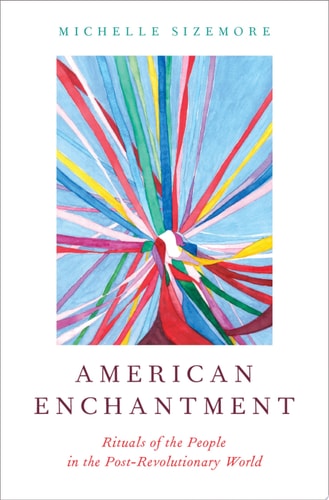
American Enchantment: Rituals of the People in the Post-Revolutionary World
0
0
As an Amazon Associate and affiliate partner, Menrva Books earns from qualifying purchases. Learn more
Author Description
The demise of the monarchy and the bodily absence of a King caused a representational crisis in the early republic, forcing the American people to reconstruct the social symbolic order in a new and unfamiliar way. Social historians have routinely understood the Revolution and the early republic as projects dedicated to and productive of reason, with "the people" as an orderly and sensible collective at odds with the volatile and unthinking crowd. American Enchantment rejects this traditionally held vision of a rational public sphere, arguing that early Americans dealt with the post-monarchical crisis by engaging in "civil mysticism," not systematic discussion and debate. By evaluating a wide range of social and political rituals and literary and cultural discourses, Sizemore shows how "enchantment" becomes a vital mode of enacting the people after the demise of traditional monarchical forms. In works by Charles Brockden Brown, Washington Irving, Catharine Sedgwick, and Nathaniel Hawthorne--as well as in Delaware oral histories, accounts of George Washington's inauguration, and Methodist conversion narratives--enchantment is an experience uniquely capable of producing new forms of popular power and social affiliation. Recognizing the role of enchantment in constituting the people overturns some of the most common-sense assumptions in the post-revolutionary world: above all, that the people are not simply a flesh-and-blood substance, but also a mystical force.
Menrva's Summary
THE THESIS
This book investigates how early Americans navigated the representational crisis following the demise of the monarchy by employing "civil mysticism" rather than purely rational discourse. Michelle Sizemore, a scholar of early American literature and culture, challenges the traditional historical view that the post-revolutionary era was defined solely by the emergence of a rational public sphere. By analyzing a diverse array of cultural artifacts and social practices, she argues that "enchantment" served as a necessary mechanism for constructing popular power and social identity in the absence of a king.
THE SCOPE MAP
What You Will Find
- Analysis of literary works by Charles Brockden Brown, Washington Irving, Catharine Sedgwick, and Nathaniel Hawthorne.
- Examination of non-literary sources including Delaware oral histories, inauguration accounts, and Methodist conversion narratives.
- A theoretical framework defining "civil mysticism" as a tool for political and social cohesion.
Scope Limits
- The study focuses primarily on the early republic period and does not extend into late 19th-century political developments.
- The analysis prioritizes symbolic and ritualistic modes of power over traditional institutional or legislative history.
THE AUTHORITY PERSPECTIVE
Scholars in the field of early American studies recognize this work as a significant intervention in the historiography of the post-revolutionary public sphere. Readers frequently note the academic density of the prose, which is intended for an audience familiar with cultural theory and historical analysis.
Page Count:
256
Publication Date:
2017-01-01
Publisher:
Oxford University Press
ISBN-10:
0190627549
ISBN-13:
9780190627546
History
National characteristics American
English & College Success
English
United States
American Studies
Literary Criticism
Social History
Cultural Anthropology
Community Tags
Similar Books