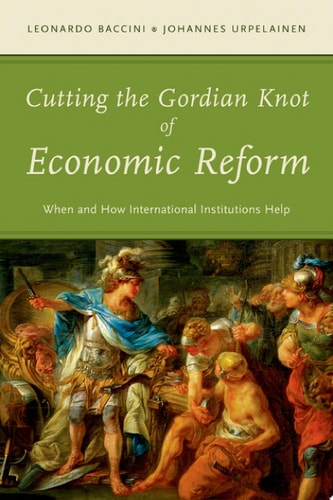
Cutting the Gordian Knot of Economic Reform: When and How International Institutions Help
0
0
As an Amazon Associate and affiliate partner, Menrva Books earns from qualifying purchases. Learn more
Author Description
Why do leaders of countries opt to sign on to international institutions that constrain their freedom to enact domestic policy? In this book, Leonardo Baccini and Johannes Urpelainen address this enduring question of international relations by looking at liberal economic reforms. During the past two decades, governments across the developing world have implemented many liberal economic reforms that reduce direct state intervention in different industries, for example with regard to intellectual property rights and privatization. While failure to implement them can have disastrous economic and political consequences, liberal economic reforms have also provoked intense political controversy domestically. Baccini and Urpelainen argue that international institutions help to cut this Gordian knot by allowing leaders to credibly commit to liberal policies while also creating domestic political support for reform. The book takes a comparative look at developing countries that have engaged in treaties with the United States and European Union to develop a full theory of when and how leaders enter into international institutions to effect economic reform.Cutting the Gordian Knot of Economic Reform is the first work to provide a theory on the design of international institutions, the circumstances that cause leaders to form international institutions, and the effects of international institutions on economic reform.
Menrva's Summary
THE THESIS
This book investigates the strategic rationale behind why national leaders voluntarily enter into international institutions that restrict their domestic policy autonomy. Authors Leonardo Baccini and Johannes Urpelainen, both established scholars in international political economy, utilize a comparative analysis of developing nations to argue that these institutions serve as commitment devices. By binding themselves to international treaties, leaders can overcome domestic political resistance to liberal economic reforms, effectively using external pressure to solidify internal policy changes.
THE SCOPE MAP
What You Will Find
- A theoretical framework explaining the design and formation of international economic institutions.
- Comparative analysis of developing countries engaging in trade and investment treaties with the United States and the European Union.
- Examination of specific policy areas including intellectual property rights and state-led privatization.
- Empirical evidence demonstrating how international commitments generate domestic political support for reform.
THE AUTHORITY PERSPECTIVE
Experts recognize this work as a significant contribution to the study of international political economy, particularly for its focus on the intersection of domestic politics and international treaty design. Readers frequently note the academic rigor of the authors' arguments and the clarity with which they address the complexities of economic liberalization in developing markets.
Page Count:
280
Publication Date:
2014-01-01
Publisher:
Oxford University Press
ISBN-10:
0199389004
ISBN-13:
9780199389001
Economics
Developing Countries
Globalization
Public Policy
International relations
Community Tags
Similar Books