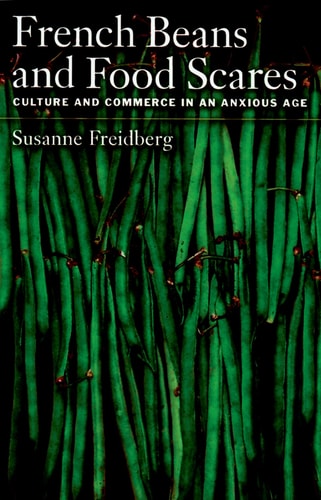
French Beans and Food Scares: Culture and Commerce in an Anxious Age
0
0
As an Amazon Associate and affiliate partner, Menrva Books earns from qualifying purchases. Learn more
Author Description
From mad cows to McDonaldization to genetically modified maize, European food scares and controversies at the turn of the millennium provoked anxieties about the perils hidden in an increasingly industrialized, internationalized food supply. These food fears have cast a shadow as long as Africa, where farmers struggle to meet European demand for the certifiably clean green bean. But the trade in fresh foods between Africa and Europe is hardly uniform. Britain and France still do business mostly with their former colonies, in ways that differ as dramatically as their national cuisines. The British buy their "baby veg" from industrial-scale farms, pre-packaged and pre-trimmed; the French, meanwhile, prefer their green beans naked, and produced by peasants. Managers and technologists coordinate the baby veg trade between Anglophone Africa and Britain, whereas an assortment of commercants and self-styled agro-entrepreneurs run the French bean trade. Globalization, then, has not erased cultural difference in the world of food and trade, but instead has stretched it to a transnational scale.French Beans and Food Scares explores the cultural economies of two "non-traditional" commodity trades between Africa and Europe--one anglophone, the other francophone--in order to show not only why they differ but also how both have felt the fall-out of the wealthy world's food scares. In a voyage that begins in the mid-19th century and ends in the early 21st, passing by way of Paris, London, Burkina Faso and Zambia, French Beans and Food Scares illuminates the daily work of exporters, importers and other invisible intermediaries in the global fresh food economy. These intermediaries' accounts provide a unique perspective on the practical and ethical challenges of globalized food trading in an anxious age. They also show how postcolonial ties shape not only different societies' geographies of food supply, but also their very ideas about what makes food good.
Menrva's Summary
THE THESIS
This book investigates how cultural differences and postcolonial legacies continue to shape the global fresh food trade despite the homogenizing pressures of industrialization and food safety anxieties. Susanne Freidberg, a scholar in geography and environmental studies, utilizes extensive fieldwork and historical analysis to contrast the British and French approaches to the African green bean trade. She argues that national food cultures and historical colonial ties dictate the logistics, management styles, and ethical standards of these transnational commodity chains.
THE SCOPE MAP
What You Will Find
- Comparative analysis of Anglophone and Francophone trade networks between Africa and Europe.
- Historical examination of food supply chains from the mid-19th century to the early 21st century.
- Qualitative evidence derived from interviews with exporters, importers, and agro-entrepreneurs.
- Exploration of how food scares influence consumer perceptions and regulatory demands in wealthy nations.
THE AUTHORITY PERSPECTIVE
Experts in food studies and economic geography recognize this work as a significant contribution to understanding the human and cultural dimensions of global supply chains. Readers frequently note the clarity with which the author connects abstract economic concepts to the daily realities of international trade intermediaries.
Page Count:
288
Publication Date:
2004-10-21
Publisher:
Oxford University Press
ISBN-10:
0195169611
ISBN-13:
9780195169614
Economics
History
Horticulture
Great Britain
United States
Globalization
Earth Sciences
Developing Countries
Food Adulteration And Inspection
Food Studies
Industrial Policy
Agriculture
Produce Trade
Sociology
Community Tags
Other Editions(2)

Similar Books








Reader Comments
Share Your Thoughts
No comments yet. Be the first to share your thoughts!