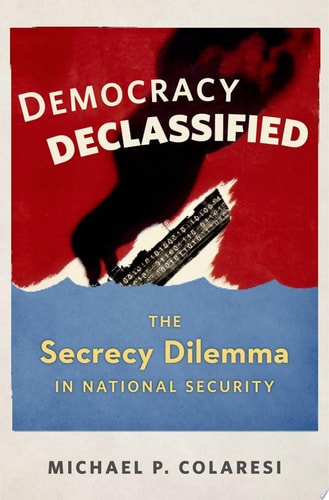
Democracy Declassified: The Secrecy Dilemma in National Security
0
0
As an Amazon Associate and affiliate partner, Menrva Books earns from qualifying purchases. Learn more
Author Description
Recent Scandals Like Wikileaks And Edward Snowden's Disclosure Of Nsa Documents Have Brought Public Debates Over Government Accountability And Secrecy Bubbling To The Surface. How Can Modern Democracies Balance The Need For Privacy In Delicate Foreign Policy Matters With The Necessity Of Openness In Gaining And Maintaining The Trust Of Citizens? Democracies Keep Secrets From Potential Enemies And Their Citizens. This Simple Fact Challenges The Surprisingly Prevalent Assumption That Foreign Policy Successes And Failures Can Be Attributed To Public Transparency And Accountability. In Fact, The Ability To Keep Secrets Has Aided Democratic Victories From The European And Pacific Theatres In World War Ii To The Global Competition Of The Cold War. At The Same Time, Executive Discretion Over The Capacity To Classify Information Created The Opportunity For Abuse That Contributed To Watergate, As Well As Domestic Spying And Repression In France, Norway And Canada Over The Past Forty Years. Therefore, Democracies Face A Secrecy Dilemma. Secrecy Is Useful, But Once A Group Or Person Has The Ability To Decide What Information Is Concealed From A Rival, Citizens Can No Longer Monitor That Information. How Then Can The Public Be Assured That National Security Policies Are Not Promoting Hidden Corruption Or Incompetence? As Democracy Declassified Shows, It Is Indeed Possible For Democracies To Keep Secrets While Also Maintaining Useful National Security Oversight Institutions That Can Deter Abuse And Reassure The Public. Understanding Secrecy And Oversight In Democracies Helps Us Explain Not Only Why The Maginot Line Rose And The French Republic Fell, Or How The Us Stumbled But Eventually Won The Cold War, But More Generally How Democracies Can Benefit From Both Public Consent And Necessary National Security Secrets. At A Time When Ubiquitous Debates Over The Issue Of Institutional Accountability And Transparency Have Reached A Fever Pitch, Democracy Declassified Provides A Ground
Menrva's Summary
THE THESIS
This book investigates the fundamental tension between the necessity of state secrecy in national security and the democratic requirement for public accountability and institutional oversight. Michael P. Colaresi, a scholar of political science and international relations, utilizes a comparative historical framework to analyze how democratic states manage classified information. He argues that while secrecy is a functional requirement for foreign policy success, it creates inherent risks of executive abuse that must be mitigated through robust oversight institutions.
THE SCOPE MAP
What You Will Find
- Comparative analysis of national security policies in the United States, France, Norway, and Canada.
- Historical case studies ranging from the World War II era to the Cold War and modern digital-age disclosures.
- A theoretical framework for evaluating the trade-offs between executive discretion and legislative monitoring.
- Evidence-based arguments regarding the efficacy of oversight institutions in preventing corruption and state repression.
THE AUTHORITY PERSPECTIVE
Experts in political science and international relations identify this work as a rigorous examination of the institutional mechanics governing state secrecy. Readers frequently note the academic density of the prose, which provides a structured approach to understanding the complex balance between security and transparency in modern governance.
Page Count:
393
Publication Date:
2014-01-01
Publisher:
Oxford University Press
ISBN-10:
0199389799
ISBN-13:
9780199389797
History
Politics
Public Policy
Kindle Store
Specific Topics
Categories
International relations
Government Information
Public Administration
National security
Kindle eBooks
Government
Community Tags
Similar Books