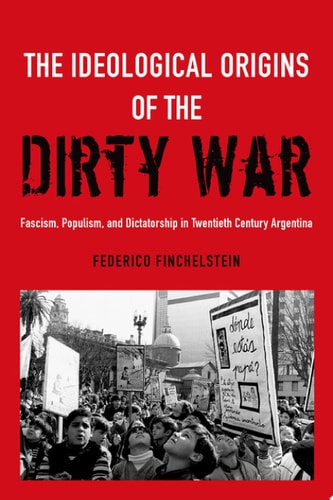
The Ideological Origins of the Dirty War: Fascism, Populism, and Dictatorship in Twentieth Century Argentina
0
0
As an Amazon Associate and affiliate partner, Menrva Books earns from qualifying purchases. Learn more
Author Description
Argentina is famous for its ties with fascism as well as its welcoming of Nazi war criminals after World War II. At mid-century, it was the home of Peronism. It was also the birthplace of the Dirty War and one of Latin America's most criminal dictatorships in the 1970s and early 1980s. How and why did all of these regimes emerge in a country that was "born liberal"? Why did these authoritarian traits first emerge in Argentina under the shadow of fascism? In this book, Federico Finchelstein tells the history of modern Argentina as seen from the perspective of political violence and ideology. He focuses on the theory and practice of the fascist idea in Argentine political culture throughout the twentieth century, analyzing the connections between fascist theory and the Holocaust, antisemitism, and the military junta's practices of torture and state violence, with its networks of concentration camps and extermination. The book demonstrates how the state's war against its citizens was rooted in fascist ideology, explaining the Argentine variant of fascism, formed by nacionalistas, and its links with European fascism and Catholicism. It particularly emphasizes the genocidal dimensions of the persecution of Argentine Jewish victims. The destruction of the rule of law and military state terror during the Dirty War, Finchelstein shows, was the product of many political and ideological reformulations and personifications of fascism.The Ideological Origins of the Dirty War provides a genealogy of state-sanctioned terror, revealing fascism as central to Argentina's political culture and its violent twentieth century.
Menrva's Summary
THE THESIS
This work investigates how fascist ideology, rather than mere political opportunism, served as the foundational catalyst for the state-sanctioned violence and systemic terror characterizing Argentina's Dirty War. Federico Finchelstein, a scholar of modern political history, utilizes an extensive analysis of twentieth-century Argentine political culture to trace the evolution of nacionalismo and its synthesis with European fascist models. By examining the intersection of Catholicism, antisemitism, and military doctrine, the author argues that the junta's practices of torture and extermination were not anomalous, but rather the logical culmination of long-standing ideological developments within the state.
THE SCOPE MAP
What You Will Find
- A historical genealogy of Argentine political violence from the mid-twentieth century through the early 1980s.
- An analysis of the ideological connections between European fascism and the specific Argentine variant promoted by nacionalistas.
- Examination of the role of antisemitism and the Holocaust as conceptual frameworks for the military junta's persecution of citizens.
- A study of the institutionalization of state terror, including the implementation of concentration camps and the systematic destruction of the rule of law.
THE AUTHORITY PERSPECTIVE
Scholars and historians recognize this text as a critical contribution to the study of Latin American authoritarianism and the global history of fascism. Readers frequently note the academic density of the prose, which provides a rigorous, evidence-based examination of how political theory translates into state-sponsored violence.
Page Count:
224
Publication Date:
2014-01-01
Publisher:
Oxford University Press
ISBN-10:
0199396507
ISBN-13:
9780199396504
History
Modern History
American History
Antisemitism
Military History
Peronism
State-sponsored Terrorism
Church & State
Fascism
Community Tags
Similar Books