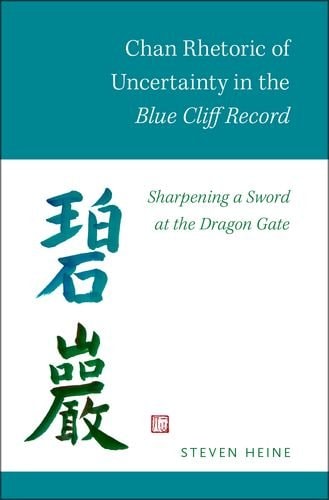
Chan Rhetoric of Uncertainty in the Blue Cliff Record: Sharpening a Sword at the Dragon Gate
0
0
As an Amazon Associate and affiliate partner, Menrva Books earns from qualifying purchases. Learn more
Author Description
This book provides an in-depth textual and literary analysis of the Blue Cliff Record (Chinese Biyanlu, Japanese Hekiganroku), a seminal Chan/Zen Buddhist collection of commentaries on one hundred gongan/koan cases, considered in light of historical, cultural, and intellectual trends from the Song dynasty (960-1279). Compiled by the disciples of Yuanwu Keqin in 1128, the Blue Cliff Record is considered a classic of East Asian literature for its creative integration of prose and verse as well as hybrid or capping-phrase interpretations of perplexing cases.The collection employs a variety of rhetorical devices culled from both classic and vernacular literary sources and styles and is particularly notable for its use of indirection, allusiveness, irony, paradox, and wordplay, all characteristic of the approach of literary or lettered Chan.However, as instrumental and influential as it is considered to be, the Blue Cliff Record has long been shrouded in controversy. The collection is probably best known today for having been destroyed in the 1130s at the dawn of the Southern Song dynasty (1127-1279) by Dahui Zonggao, Yuanwu's main disciple and harshest critic. It was out of circulation for nearly two centuries before being revived and partially reconstructed in the early 1300s. In this book, Steven Heine examines the diverse ideological connections and disconnections behind subsequent commentaries and translations of the Blue Cliff Record, thereby shedding light on the broad range of gongan literature produced in the eleventh to thirteenth centuries and beyond.
Menrva's Summary
THE THESIS
*This book investigates the rhetorical strategies and historical controversies surrounding the Blue Cliff Record, a foundational text of Chan Buddhism.* Steven Heine, a scholar of East Asian religions, utilizes a rigorous textual and literary analysis to explore how this collection of one hundred koans integrates prose and verse to convey complex philosophical insights. By examining the ideological tensions between Yuanwu Keqin and his disciple Dahui Zonggao, the author provides a framework for understanding the evolution of 'lettered Chan' during the Song dynasty.
THE SCOPE MAP
What You Will Find
- A detailed examination of the Blue Cliff Record (Biyanlu) and its historical context within the Song dynasty.
- Analysis of rhetorical devices including irony, paradox, indirection, and wordplay used in Chan commentary.
- Historical investigation into the destruction and subsequent reconstruction of the text by Dahui Zonggao.
- An exploration of the ideological connections and disconnections in the transmission of gongan literature.
THE AUTHORITY PERSPECTIVE
Scholars and students of Zen Buddhism recognize this work as a significant contribution to the understanding of Chan literary history. Readers frequently note the academic density of the prose, which provides a comprehensive look at the intellectual climate of the twelfth and thirteenth centuries.
Page Count:
360
Publication Date:
2016-05-30
Publisher:
Oxford University Press
ISBN-10:
0199397767
ISBN-13:
9780199397761
Philosophy
Religion
History
Literary Criticism
Buddhism
Asian Studies
Koan lemac
Zen
Community Tags
Similar Books