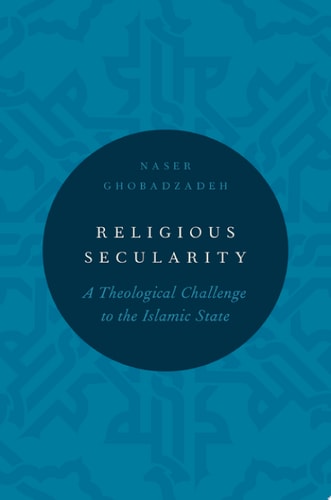
Religious Secularity: A Theological Challenge to the Islamic State
0
0
As an Amazon Associate and affiliate partner, Menrva Books earns from qualifying purchases. Learn more
Author Description
"Fundamentalism" and "authoritarian secularism" are commonly perceived as the two mutually exclusive paradigms available to Muslim majority countries. Recent political developments, however, have challenged this perception. Formerly associated with a fundamentalist outlook, mainstream Islamist groups, such as the Muslim Brotherhood and Al-Nahda, have adopted a distinctly secular-democratic approach to the state re-building process. Their success or failure in transitioning to democracy remains to be seen, but the political position these Islamic groups have carved out suggests the viability of a third way. Naser Ghobadzadeh examines the case of Iran, which has a unique history with respect to the relationship of religion and politics. The country has been subject to both authoritarian secularization and authoritarian Islamization over the last nine decades. While politico-religious discourse in Iran is articulated in response to the Islamic state, it also bears the scars of Iran's history of authoritarian secularization-the legacy of the Pahlavi regime. Ghobadzadeh conceptualizes this politico-religious discourse as "religious secularity". He uses this apparent oxymoron to describe the Islamic quest for a democratic secular state, and he demonstrates how this concept encapsulates the complex characteristics of the Shiite religious reformation movement.
Menrva's Summary
THE THESIS
This book investigates the viability of "religious secularity" as a third-way political framework for Muslim-majority nations seeking to reconcile Islamic identity with democratic governance. Naser Ghobadzadeh, a scholar of Middle Eastern politics, utilizes the historical trajectory of Iran to challenge the binary perception that countries must choose between fundamentalism and authoritarian secularism. By analyzing the political evolution of Islamist groups and the specific case of Iranian Shiite discourse, the author argues that a synthesis of religious values and secular-democratic state structures is not only possible but currently emerging as a significant political phenomenon.
THE SCOPE MAP
What You Will Find
- An analysis of the historical impact of both authoritarian secularization and authoritarian Islamization in Iran over the last nine decades.
- A conceptual framework defining "religious secularity" as a mechanism for democratic state-building.
- Examination of mainstream Islamist movements, including the Muslim Brotherhood and Al-Nahda, and their shift toward democratic approaches.
- A study of the Shiite religious reformation movement and its influence on contemporary politico-religious discourse.
THE AUTHORITY PERSPECTIVE
Scholars and political analysts identify this work as a significant contribution to the study of religion and global politics, particularly for its nuanced treatment of the Iranian political landscape. Readers frequently note the academic density of the prose, which serves as a foundational text for those examining the intersection of Islamic theology and modern democratic theory.
Page Count:
288
Publication Date:
2014-01-01
Publisher:
Oxford University Press
ISBN-10:
0199391181
ISBN-13:
9780199391189
Religion
Islam And State
Islamic Studies
Secularism
Democracy
Shiites
Community Tags
Other Editions(2)

Similar Books