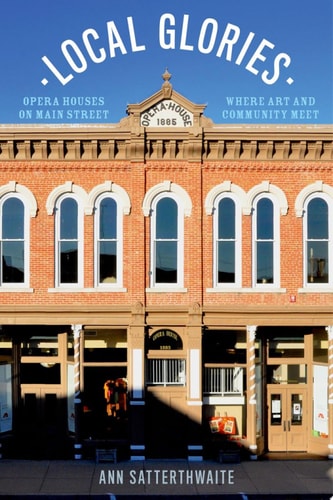
Local Glories: Opera Houses on Main Street, Where Art and Community Meet
0
0
As an Amazon Associate and affiliate partner, Menrva Books earns from qualifying purchases. Learn more
Author Description
To most people, the term "opera house" conjures up images of mink-coated dowagers accompanied by tuxedo-clad men in the gilded interiors of opulent buildings like the Met in New York or La Scala in Milan. However, the opera house in the United States has a far more varied-and far more interesting-history than that stereotype implies. In Local Glories, Ann Satterthwaite explores the creative, social, and communal roles of the thousands of opera houses that flourished in small towns across the country. By 1900, opera houses were everywhere: on second floors over hardware stores, in grand independent buildings, in the back rooms of New England town halls, and even in the bowels of a Mississippi department store. With travel made easier by the newly expanded rail lines, Sarah Bernhardt, Mark Twain, and John Philip Sousa entertained thousands of townspeople, as did countless actors, theater and opera companies, innumerable minor league magicians, circuses, and lecturers, and even 500 troupes that performed nothing but Uncle Tom's Cabin. Often the town's only large space for public assembly, the local opera house served as a place for local activities such as school graduations, recitations, sports, town meetings, elections, political rallies, and even social dances and roller skating parties. Considered local landmarks, often in distinctive architect-designed buildings, they aroused considerable pride and reinforced town identity. By considering states with distinctly different histories--principally Maine, Nebraska, Vermont, New York, and Colorado--Satterthwaite describes the diversity of opera houses, programs, audiences, buildings, promoters, and supporters--and their hopes, dreams, and ambitions.In the twentieth century, radio and movies, and later television and changing tastes made these opera houses seem obsolete. Some were demolished, while others languished for decades until stalwart revivers discovered them again in the 1970s. The resuscitation of these opera h
Menrva's Summary
THE THESIS
This book investigates the historical, social, and architectural significance of small-town opera houses in the United States, challenging the perception that these venues were exclusively elite institutions. Author Ann Satterthwaite, a planning and urban design expert, utilizes historical records and architectural surveys to argue that these buildings functioned as vital, multi-purpose community hubs. By examining diverse regions including Maine, Nebraska, and Colorado, she demonstrates how these spaces facilitated both high culture and local civic life before the advent of mass media.
THE SCOPE MAP
What You Will Find
- Historical analysis of the proliferation of opera houses in American small towns between the late 19th and early 20th centuries.
- Examination of the diverse architectural forms these venues took, from town hall back rooms to independent grand structures.
- Documentation of the wide range of programming, including traveling theater troupes, lecturers, and local civic events.
- Case studies of specific states to illustrate the regional variations in how these buildings were promoted, sustained, and eventually repurposed.
THE AUTHORITY PERSPECTIVE
Experts and architectural historians recognize this work as a comprehensive study of a neglected aspect of American civic history. Readers frequently note the accessible prose and the author's ability to connect architectural preservation with broader social trends in rural communities.
Page Count:
446
Publication Date:
2016-01-01
Publisher:
Oxford University Press
ISBN-10:
0199392560
ISBN-13:
9780199392568
Architecture
History
Americana
Public Policy
United States
Special Topics
Humanities
American History
Theater And Society
Community Tags
Similar Books