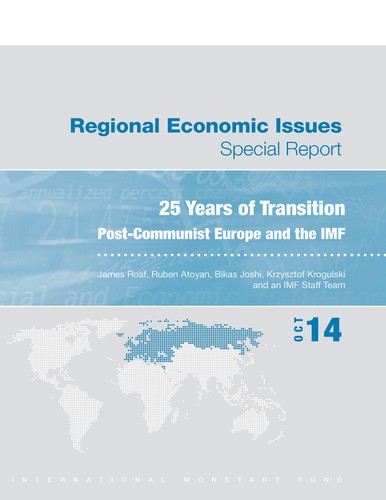
25 Years of Transition: Post-Communist Europe and the IMF
0
0
As an Amazon Associate and affiliate partner, Menrva Books earns from qualifying purchases. Learn more
Author Description
The past 25 years have seen a dramatic transformation in Europe's former communist countries, resulting in their reintegration with the global economy, and, in most cases, major improvements in living standards. But the task of building full market economies has been difficult and protracted. Liberalisation of trade and prices came quickly, but institutional reforms - such as governance reform, competition policy, privatisation and enterprise restructuring - often faced opposition from vested interests. The results of the first years of transition were uneven. All countries suffered high inflation and major recessions as prices were freed and old economic linkages broke down. But the scale of output losses and the time taken for growth to return and inflation to be brought under control varied widely. Initial conditions and external factors played a role, but policies were critical too. Countries that undertook more front-loaded and bold reforms were rewarded with faster recovery and income convergence. Others were more vulnerable to the crises that swept the region in the wake of the 1997 Asia crisis.--
Menrva's Summary
THE THESIS
This book examines the complex and often uneven economic and institutional reforms undertaken by former communist countries in Europe over the 25 years following the collapse of communism. The author, Bikas Joshi, analyzes the challenges faced in transitioning to market economies, including the difficulties in implementing reforms such as governance, competition policy, and privatization due to opposition from vested interests. The book details how initial conditions and external factors influenced the varied outcomes, but critically emphasizes the role of policy choices in determining the speed of recovery and income convergence, particularly in light of regional crises like the 1997 Asian financial crisis.
THE SCOPE MAP
- Analysis of the economic transformation in post-communist European countries over a 25-year period.
- Examination of the challenges in building full market economies, including institutional reforms.
- Discussion of the impact of trade and price liberalization versus slower institutional reforms.
- Comparison of the uneven results of transition, including inflation and recessions.
- Assessment of the role of initial conditions, external factors, and policy choices in recovery.
- Case studies or examples of countries that adopted front-loaded reforms versus those that did not.
- Impact of regional crises, such as the 1997 Asian crisis, on transition economies.
THE AUTHORITY PERSPECTIVE
The book analyzes the economic transition in post-communist Europe, highlighting the critical role of policy choices in recovery and income convergence. It suggests that countries undertaking more decisive reforms experienced faster growth. The analysis likely provides a detailed account of the challenges and varied outcomes across different nations during this significant geopolitical and economic shift.
Page Count:
72
Publication Date:
2014-01-01
ISBN-10:
1498305636
ISBN-13:
9781498305631
Politics
Economics
History
Non-Fiction
Community Tags
Similar Books