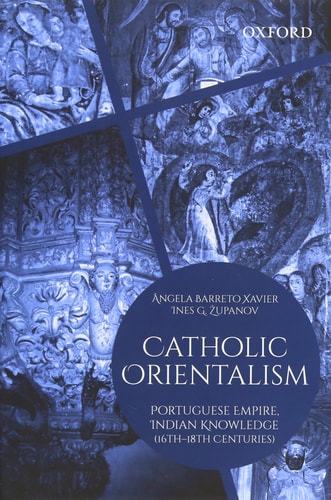
Catholic Orientalism: Portuguese Empire, Indian Knowledge (16th-18th Centuries)
0
0
As an Amazon Associate and affiliate partner, Menrva Books earns from qualifying purchases. Learn more
Author Description
This book explores the process of knowledge production in and about South Asia during the late medieval and early modern periods. Disseminated through the global networks of the early modern Portuguese empire (16th-18th centuries), this process was inextricably connected to the expansion of Catholicism and was geared to perpetuate political ambitions and cultural imaginary of the early modern Catholic protagonists and their communities in South Asia and beyond.As an integral part of the Portuguese imperial 'information order' established in Asia, Catholic Orientalism was responsible for creating an epistemic tool box, in which several significant concepts were first tested and developed: such as "caste," "Brahmanism," "paganism," "the torrid zone," "oriental despotism," and many others. However, from the mid-18th century, the British empire changed the map of knowledge about South Asia and in the process Catholic Orientalism was both assimilated and discarded as tainted by unreasonable Catholicism and too close to equally unreasonable "native" Indian point of view.Through a series of case studies, this book chronicles the rise and the decline of the Catholic knowledge of South Asia which had not been, at any point, only and simply "Portuguese." Multiple sources, polyglot archives and actors moving ever more swiftly through space and time, with divided loyalties, often disregarding "national" divisions and wearing many different hats are at the heart of the narrative which starts at the turn of the 16th century and ends by the end of the 18th.
Menrva's Summary
THE THESIS
This book investigates how the Portuguese empire constructed a specific epistemic framework, termed 'Catholic Orientalism,' to categorize and control knowledge about South Asia between the 16th and 18th centuries. Angela Barreto Xavier and Ines G. Zupanov utilize extensive archival research to demonstrate how religious expansion and political ambition intersected to create enduring concepts like 'caste' and 'Brahmanism.' The authors argue that this knowledge production was a collaborative, polyglot effort that preceded and influenced later British imperial intellectual structures.
THE SCOPE MAP
What You Will Find
- Analysis of the Portuguese imperial 'information order' in South Asia.
- Examination of key conceptual developments including 'paganism,' 'the torrid zone,' and 'oriental despotism.'
- Case studies utilizing diverse, multilingual archival sources and historical actors.
- A chronological study of the rise and eventual decline of Catholic-centered knowledge systems in the region.
THE AUTHORITY PERSPECTIVE
Scholars recognize this work as a significant contribution to the history of knowledge production and colonial studies. Readers frequently note the academic density of the prose and the authors' meticulous use of polyglot archives to challenge traditional nationalistic historical narratives.
Page Count:
416
Publication Date:
2014-11-27
Publisher:
Oxford University Press
ISBN-10:
0199452679
ISBN-13:
9780199452675
History
Religion
Philosophy
Colonialism
Catholic Church
Community Tags
Similar Books