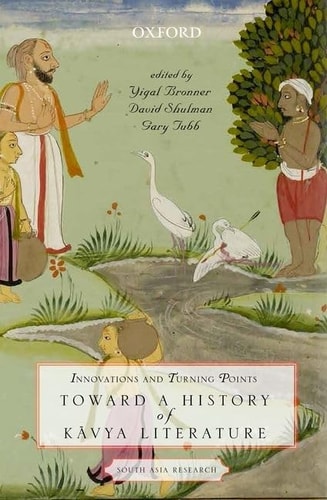
Innovations and Turning Points: Toward a History of Kavya Literature
0
0
As an Amazon Associate and affiliate partner, Menrva Books earns from qualifying purchases. Learn more
Author Description
This volume is the first attempt to offer a panoramic historical overview of South Asian classical poetry, especially in Sanskrit. Many of the essays in this volume are the first serious studies of the great masterpieces of South Asian literature. Moreover, the book as a whole captures the millennium-long developmental logic of kavya literature by identifying a series of critical moments of breakthrough and innovation-that is, moments when the basic rules of composition and the aesthetic and poetic goals underwent dramatic change, allowing the tradition to reinvent itself. Individual sections thus focus on the beginnings of kavya literature and Kalidasa's creation of what came to be its classical form; the new poetic model that emerged from the intense competition and conversation of Bharavi and Magha in the middle of the first millennium; the extended revolutionary period in Kanauj, where Bana and his successors reconceived the meaning and practice of Sanskrit poetry; and the no less transformative period at the beginning of the second millennium, when poets of genius such as Sriharsa were active in the context of India's nascent vernacularization. The scope of the volume extends beyond Sanskrit to early modern Hindi, and beyond the subcontinent and the Himalayas to Java and Tibet, where kavya found a new home and continued to evolve. A general introduction proposes a theoretical framework for the study of this immense literary tradition in terms of its continuous self-reinvention.
Menrva's Summary
THE THESIS
This volume investigates the historical development of Sanskrit kavya literature by identifying the critical moments of innovation that allowed the tradition to sustain itself over a millennium. The authors, Yigal Bronner, David Shulman, and Gary Tubb, utilize a collection of scholarly essays to map the evolution of poetic composition and aesthetic goals. By analyzing specific breakthroughs in the history of South Asian poetry, the text provides a theoretical framework for understanding how classical literature reinvented its own rules and practices across centuries.
THE SCOPE MAP
What You Will Find
- A historical analysis of Sanskrit kavya from its origins through the second millennium.
- Examination of key poets including Kalidasa, Bharavi, Magha, Bana, and Sriharsa.
- Comparative studies extending to early modern Hindi and the reception of kavya in Java and Tibet.
- A theoretical framework for interpreting literary tradition through the lens of continuous self-reinvention.
THE AUTHORITY PERSPECTIVE
Scholars recognize this volume as a foundational text for the study of classical South Asian poetry, noting its success in synthesizing complex historical shifts into a coherent narrative. Readers frequently highlight the academic density of the prose, which serves as a primary resource for students and researchers of Sanskrit literature.
Page Count:
816
Publication Date:
2014-11-25
Publisher:
Oxford University Press
ISBN-10:
0199453551
ISBN-13:
9780199453559
Poetry
History
Asian Studies
Sanskrit
Criticism history
Literary Criticism
Community Tags
Similar Books