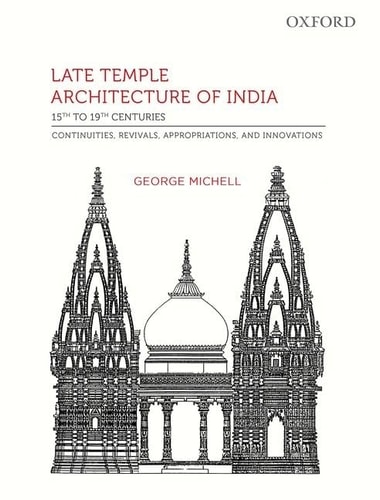
Late Temple Architecture of India, 15th to 19th Centuries: Continuities, Revivals, Appropriations, and Innovations
0
0
As an Amazon Associate and affiliate partner, Menrva Books earns from qualifying purchases. Learn more
Author Description
From the fifteenth century on, after a period of widespread destruction and demolition, India witnessed a resumption of temple patronage and building activity. These late temples, however, are usually overlooked by architectural and art historians, who tend to privilege the earlier phases of Indian architecture and art, the prevailing assumption being that India's late temples are unworthy of serious attention. As illustrated in this volume, nothing could be further from the truth. Accompanied by maps, photographs, as well as a selection of building plans, this book is the first wide-ranging account of temple architecture in the 500-year period that coincides with the rule of the sultanates, the Mughals, and the British. Through a meticulous study of over 300 temples from 17 geographical zones, this book shows that, as far as temple architecture is concerned, these years were remarkably creative and vibrant. The temples built during this period display a startling diversity of forms, structural techniques, and aesthetic qualities. Rather than characterizing the appearance of domes, vaults, pointed arches, and other such borrowings as inappropriately 'Christian' or 'Islamic', this volume attempts to understand how such attributes came to be integrated into a Hindu and Jain religious context.
Menrva's Summary
THE THESIS
This volume investigates the architectural evolution and creative resilience of Indian temple construction between the 15th and 19th centuries, challenging the academic bias that dismisses this era as a period of decline. George Michell, a renowned authority on Indian architecture, utilizes a vast dataset of over 300 temples across 17 distinct geographical zones to argue that this period was one of significant innovation rather than stagnation. By analyzing the integration of foreign structural elements—such as domes and arches—into traditional Hindu and Jain contexts, the author provides a framework for understanding how religious architecture adapted to the shifting political landscapes of the Sultanate, Mughal, and British eras.
THE SCOPE MAP
What You Will Find
- A comprehensive survey of over 300 temples spanning 500 years of Indian history.
- Analysis of 17 distinct geographical zones and their unique regional architectural styles.
- Integration of primary source evidence including building plans, site maps, and photographic documentation.
- A critical examination of how structural borrowings from Islamic and Western traditions were synthesized into indigenous religious frameworks.
THE AUTHORITY PERSPECTIVE
Experts recognize this work as a vital corrective to the traditional art historical narrative that prioritizes earlier medieval periods over later developments. Scholars frequently highlight the book's meticulous documentation and its success in elevating the status of late-period temple architecture within the broader field of South Asian studies.
Page Count:
352
Publication Date:
2015-05-26
Publisher:
Oxford University Press
ISBN-10:
0199454671
ISBN-13:
9780199454679
Architecture
Cultural History
Temples
Architecture india
Indian History
Art History
Community Tags
Similar Books