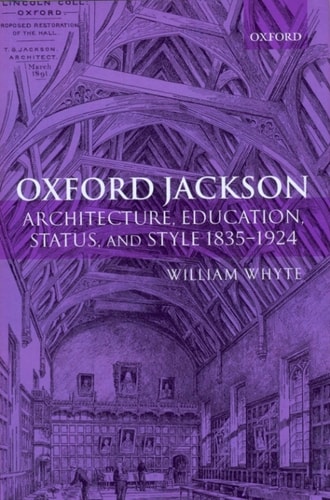
Oxford Jackson: Architecture, Education, Status, and Style 1835-1924
0
0
As an Amazon Associate and affiliate partner, Menrva Books earns from qualifying purchases. Learn more
Author Description
In the late nineteenth century one man changed Oxford forever. T. G. Jackson built the Examination Schools, the Bridge of Sighs, worked at a dozen colleges, and restored a score of other Oxford icons. He also built for many of the major public schools, for the University of Cambridge, and at the Inns of Court. A friend of William Morris, he was a pioneering member of the arts and crafts moment. A distinguished historian, he also restored dozens of houses and churches - and ensured the survival of Winchester Cathedral. As an architectural theorist he was a leader of the generation that rejected the Gothic Revival and sought to develop a new and modern style of building. Drawing on extensive archival work, and illustrated with a hundred images, this is the first in-depth analysis of Jackson's career ever written. It sheds light on a little-known architect and reveals that his buildings, his books, and his work as an arts and craftsman were not just important in their own right, they were also part of a wider social change. Jackson was the architect of choice for a particular group of people, for the 'intellectual aristocracy' of late Victorian England. His buildings were a means by which they could articulate their identity and demonstrate their distinctiveness. They reformed the universities and the schools whilst he refashioned their image. Essential reading for anyone interested in Victorian architecture and nineteenth-century society, this book will also be of interest to all those who know and love Oxford or Cambridge.
Menrva's Summary
THE THESIS
This work investigates how the architectural career of T. G. Jackson served as a physical manifestation of the social identity and status of the late Victorian intellectual aristocracy. William Whyte, a historian specializing in the built environment, utilizes extensive archival research to analyze Jackson's influence on the landscape of Oxford, Cambridge, and major public schools. The author argues that Jackson's rejection of the Gothic Revival in favor of a new, modern aesthetic was not merely a stylistic choice, but a deliberate effort to articulate the values and distinctiveness of the elite class he served. By examining his buildings alongside his theoretical writings, Whyte demonstrates how Jackson's work facilitated the institutional reform of British universities and schools during a period of significant social transition.
THE SCOPE MAP
What You Will Find
- A comprehensive analysis of T. G. Jackson's architectural projects, including the Examination Schools and the Bridge of Sighs.
- An examination of the relationship between architectural style and the social identity of the Victorian intellectual elite.
- A detailed account of Jackson's role within the Arts and Crafts movement and his influence on architectural theory.
- Over one hundred images documenting his restoration work and original designs.
Scope Limits
- The study is primarily focused on the period between 1835 and 1924, limiting its scope to the late Victorian and Edwardian eras.
- The text does not provide a general history of Oxford architecture, focusing specifically on the impact of Jackson's individual contributions.
THE AUTHORITY PERSPECTIVE
Scholars and architectural historians recognize this monograph as the definitive study of T. G. Jackson's career and his broader influence on nineteenth-century institutional design. Readers frequently note the academic density of the prose and the depth of the archival research, which provides a rigorous look at the intersection of social history and the built environment.
Page Count:
288
Publication Date:
2006-01-01
Publisher:
Clarendon Press
ISBN-10:
0191516333
ISBN-13:
9780191516337
Biography
Architecture
History
European History
Architects biography
Education - History
Art History
Community Tags
Similar Books