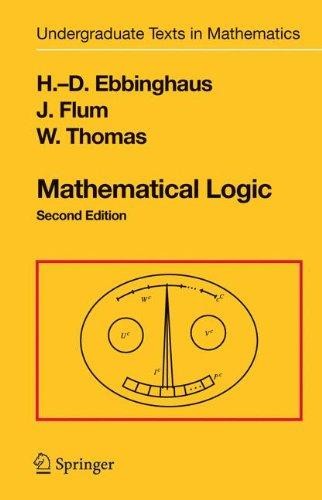
Mathematical Logic
0
0
As an Amazon Associate and affiliate partner, Menrva Books earns from qualifying purchases. Learn more
Author Description
This junior/senior level text is devoted to a study of first-order logic and its role in the foundations of mathematics: What is a proof? How can a proof be justified? To what extent can a proof be made a purely mechanical procedure? How much faith can we have in a proof that is so complex that no one can follow it through in a lifetime? The first substantial answers to these questions have only been obtained in this century. The most striking results are contained in Goedel's work: First, it is possible to give a simple set of rules that suffice to carry out all mathematical proofs; but, second, these rules are necessarily incomplete - it is impossible, for example, to prove all true statements of arithmetic. The book begins with an introduction to first-order logic, Goedel's theorem, and model theory. A second part covers extensions of first-order logic and limitations of the formal methods. The book covers several advanced topics, not commonly treated in introductory texts, such as Trachtenbrot's undecidability theorem. Fraissé's elementary equivalence, and Lindstroem's theorem on the maximality of first-order logic.
Menrva's Summary
THE THESIS
This text investigates the fundamental questions surrounding mathematical logic and its role in the foundations of mathematics. It explores the nature of proof, its justification, and the possibility of mechanical procedures for its execution. The book addresses the limitations of formal systems, particularly in light of Gödel's incompleteness theorems, which demonstrate that not all true arithmetic statements can be proven within a given formal system. The author, H.-D. Ebbinghaus, a recognized authority in the field, guides the reader through these complex concepts.
THE SCOPE MAP
- Introduction to first-order logic
- Gödel's incompleteness theorems
- Model theory
- Extensions of first-order logic
- Limitations of formal methods
- Trachtenbrot's undecidability theorem
- Fraïssé's elementary equivalence
- Lindström's theorem on the maximality of first-order logic
THE AUTHORITY PERSPECTIVE
This book is recognized as a comprehensive and advanced treatment of mathematical logic, suitable for junior/senior level students. It delves into foundational questions and presents key results from 20th-century logic, including Gödel's seminal work. The inclusion of advanced topics not typically found in introductory texts suggests a rigorous and in-depth exploration of the subject matter. The text is likely to be appreciated by those seeking a deep understanding of formal systems and their inherent limitations.
Page Count:
291
Publication Date:
1994-01-01
ISBN-10:
1475723571
ISBN-13:
9781475723571
Science
Non-Fiction
Formal Systems
Mathematics
Foundations of Mathematics
Set Theory
Logic
Community Tags
Similar Books