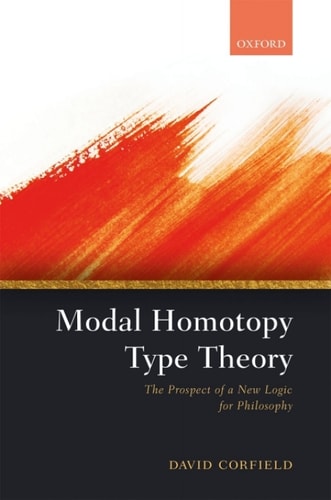
Modal Homotopy Type Theory: The Prospect of a New Logic for Philosophy
0
0
As an Amazon Associate and affiliate partner, Menrva Books earns from qualifying purchases. Learn more
Author Description
"The old logic put thought in fetters, while the new logic gives it wings." For the past century, philosophers working in the tradition of Bertrand Russell - who promised to revolutionise philosophy by introducing the 'new logic' of Frege and Peano - have employed predicate logic as their formal language of choice. In this book, Dr David Corfield presents a comparable revolution with a newly emerging logic - modal homotopy type theory. Homotopy type theory has recently been developed as a new foundational language for mathematics, with a strong philosophical pedigree. Modal Homotopy Type Theory: The Prospect of a New Logic for Philosophy offers an introduction to this new language and its modal extension, illustrated through innovative applications of the calculus to language, metaphysics, and mathematics. The chapters build up to the full language in stages, right up to the application of modal homotopy type theory to current geometry. From a discussion of the distinction between objects and events, the intrinsic treatment of structure, the conception of modality as a form of general variation to the representation of constructions in modern geometry, we see how varied the applications of this powerful new language can be.
Menrva's Summary
THE THESIS
Can modal homotopy type theory serve as a more expressive and flexible foundational language for philosophy than traditional predicate logic? Dr. David Corfield argues that the limitations of Russellian predicate logic necessitate a shift toward homotopy type theory, a framework rooted in modern mathematics. By introducing modal extensions, Corfield demonstrates how this new logic provides a robust structure for addressing complex problems in metaphysics, linguistics, and geometry.
THE SCOPE MAP
What You Will Find
- An introduction to the foundational principles of homotopy type theory.
- Applications of modal extensions to metaphysical concepts and linguistic structures.
- A step-by-step progression from basic logical constructions to advanced geometric representations.
Scope Limits
- The text assumes a baseline familiarity with formal logic and mathematical concepts.
- It does not provide an exhaustive history of all non-classical logics, focusing specifically on the homotopy-based approach.
THE AUTHORITY PERSPECTIVE
Experts identify this work as a significant contribution to the intersection of mathematical logic and contemporary analytic philosophy. Readers frequently note the technical density of the prose, which requires careful engagement with the formalisms presented.
Page Count:
192
Publication Date:
2020-01-01
Publisher:
OUP Oxford
ISBN-10:
0192595032
ISBN-13:
9780192595034
Philosophy
Metaphysics
Type Theory
Logic
Logic & Critical Reasoning
Formal Systems
Mathematics
Community Tags
Similar Books