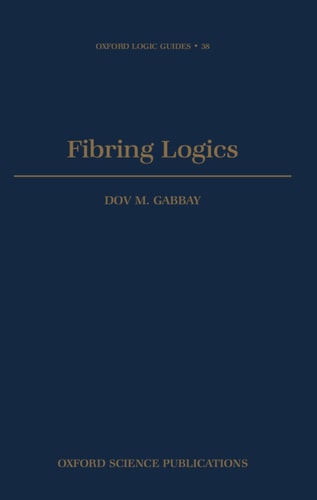
Fibring Logics
0
0
As an Amazon Associate and affiliate partner, Menrva Books earns from qualifying purchases. Learn more
Author Description
Modern Applications Of Logic, In Mathematics, Theoretical Computer Science, And Linguistics, Require Combined Systems Involving Many Different Logics Working Together. In This Book The Author Offers A Basic Methodology For Combining-or Fibring-systems. This Means That Many Existing Complex Systems Can Be Broken Down Into Simpler Components, Hence Making Them Much Easier To Manipulate. Using This Methodology The Book Discusses Ways Of Obtaining A Wide Variety Of Multimodal, Modal Intuitionistic, Modal Substructural And Fuzzy Systems In A Uniform Way. It Also Covers Self-fibred Languages Which Allow Formulae To Apply To Themselves. The Book Also Studies Sufficient Conditions For Transferring Properties Of The Component Logics Into Properties Of The Combined System.
Menrva's Summary
THE THESIS
This book investigates the formal methodology of 'fibring' as a unified framework for combining disparate logical systems into complex, functional architectures. Dov M. Gabbay, a prominent researcher in logic and computer science, utilizes his extensive background in non-classical logics to propose a systematic approach for decomposing complex systems into manageable components. The text argues that by understanding the interaction between simpler logical building blocks, one can derive properties for multimodal, intuitionistic, and fuzzy systems in a consistent manner.
THE SCOPE MAP
What You Will Find
- A comprehensive methodology for the fibring of logical systems.
- Analysis of multimodal, modal intuitionistic, and modal substructural systems.
- Exploration of self-fibred languages and recursive formula application.
- Theoretical conditions for the transfer of properties from component logics to combined systems.
Scope Limits
- The text does not provide an exhaustive survey of all existing non-classical logics.
- It assumes a high level of prior knowledge in formal logic and mathematical notation.
THE AUTHORITY PERSPECTIVE
Experts in the field of formal logic recognize this work as a foundational text for understanding the mechanics of combining logical systems. Readers frequently note the high level of technical density, making it a specialized resource for researchers in theoretical computer science and mathematical logic.
Page Count:
488
Publication Date:
1998-01-01
Publisher:
Clarendon Press
ISBN-10:
019159010X
ISBN-13:
9780191590108
Linguistics
Logic
Formal Systems
Mathematics
Computer Science