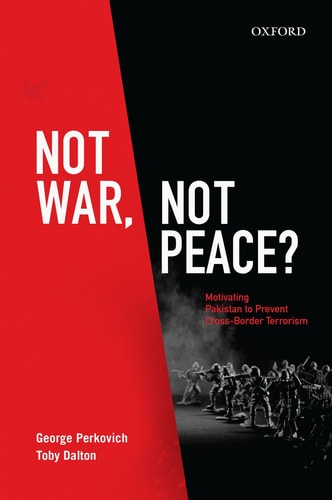
Not War, Not Peace?: Motivating Pakistan to Prevent Cross-Border Terrorism
0
0
As an Amazon Associate and affiliate partner, Menrva Books earns from qualifying purchases. Learn more
Author Description
The Mumbai blasts of 1993, the attack on the Indian Parliament in 2001, Mumbai 26/11- cross-border terrorism has continued unabated. What can India do to motivate Pakistan to do more to prevent such attacks? In the nuclear times that we live in, where a military counter-attack could escalate to destruction beyond imagination, overt warfare is clearly not an option.But since outright peacemaking seems similarly infeasible, what combination of coercive pressure and bargaining could lead to peace? The authors provide, for the first time, a comprehensive assessment of the violent and non-violent options available to India for compelling Pakistan to take concrete steps towards curbing terrorism originating in its homeland. They draw on extensive interviews with senior Indian and Pakistani officials, in service and retired, to explore the challenges involved in compellence and to show how non-violent coercion combined with clarity on the economic, social, and reputational costs of terrorism can better motivate Pakistan to pacify groups involved in cross-border terrorism.Not War, Not Peace? goes beyond the much discussed theories of nuclear deterrence and counterterrorism strategy to explore a new approach to resolving old conflicts.
Menrva's Summary
THE THESIS
This book investigates how India can effectively motivate Pakistan to curb cross-border terrorism without resorting to conventional warfare that risks nuclear escalation. George Perkovich and Toby Dalton, both established experts in nuclear policy and South Asian security, utilize a framework of coercive diplomacy to analyze the stalemate between the two nations. By synthesizing extensive interviews with high-level officials from both sides, the authors evaluate the efficacy of various non-violent pressure tactics, including economic sanctions and reputational costs, to compel policy shifts within the Pakistani state.
THE SCOPE MAP
What You Will Find
- Analysis of historical cross-border attacks including the 1993 Mumbai blasts and the 2001 Parliament attack.
- A strategic framework for non-violent coercion and diplomatic bargaining.
- Primary source data derived from interviews with retired and active Indian and Pakistani officials.
- Evaluation of the economic, social, and reputational costs of state-sponsored terrorism.
THE AUTHORITY PERSPECTIVE
Experts in international security identify this work as a critical examination of the limitations of traditional deterrence in the context of nuclear-armed neighbors. Readers frequently note the analytical rigor and the pragmatic approach the authors take toward resolving long-standing regional tensions.
Page Count:
310
Publication Date:
2016-10-25
Publisher:
Oxford University Press
ISBN-10:
0199467498
ISBN-13:
9780199467495
History
Politics
World politics
Kindle eBooks
Terrorism
Specific Topics
Kindle Store
International relations
Categories
Military Strategy
Community Tags
Similar Books