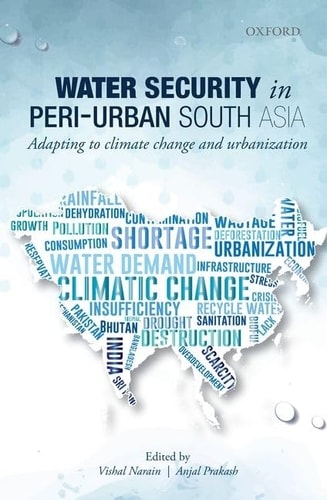
Water Security in Peri-urban South Asia: Adapting to Climate Change and Urbanization
0
0
As an Amazon Associate and affiliate partner, Menrva Books earns from qualifying purchases. Learn more
Author Description
Are our urban spaces growing thirsty by the day? What implications do unplanned urban expansion and climate change have on judicious accessibility to water resources among the multitudes who have made urban fringes their home in South Asia? A significant gap exists in current studies of adaptation and vulnerability to the vagaries of climate change that tend to focus on purely agrarian or urban contexts.Addressing this lack, this volume documents and analyses the experiences of this urban periphery in three developing nations, India, Nepal, and Bangladesh, in terms of water security and access, adaptation to climate change, and urban expansion. Cutting across disciplinary boundaries, and using a mix of qualitative and quantitative methods from natural and social sciences, the essays explore the drivers of vulnerability in four peri-urban sites Hyderabad and Gurgaon in India, Khulna in Bangladesh, and Kathmandu in Nepal and examine the cost-effectiveness of technological and institutional alternatives to build adaptive capacity. The essays explore how different groups of people, men and women, face differential vulnerabilities to water insecurity induced by urbanization and climate change and how they adapt through technological or institutional innovation.
Menrva's Summary
THE THESIS
This volume investigates how the intersection of rapid, unplanned urban expansion and climate change creates critical water insecurity for populations residing in the peri-urban fringes of South Asia. The authors, Anjal Prakash and Vishal Narain, utilize a multidisciplinary framework that synthesizes natural and social science data to evaluate the vulnerability of these transitional zones. By examining specific case studies across India, Nepal, and Bangladesh, the text argues that current adaptation strategies must account for the unique socio-economic pressures of the urban periphery to be effective.
THE SCOPE MAP
What You Will Find
- Comparative analysis of peri-urban water security in Hyderabad, Gurgaon, Khulna, and Kathmandu.
- Evaluation of technological and institutional alternatives for building adaptive capacity.
- Qualitative and quantitative research methods assessing differential vulnerabilities based on gender and social status.
- Examination of the drivers of water insecurity within the context of climate change and rapid urbanization.
THE AUTHORITY PERSPECTIVE
Experts identify this work as a significant contribution to the field of urban studies, specifically for its focus on the often-overlooked peri-urban interface. Readers frequently note the academic density of the prose and the value of its cross-disciplinary approach to regional water management.
Page Count:
336
Publication Date:
2016-09-28
Publisher:
Oxford University Press
ISBN-10:
0199464162
ISBN-13:
9780199464166
Sociology
Water Supply
Climate Change
urban planning
Climatic changes
South Asia
Water Resources
Community Tags
Similar Books