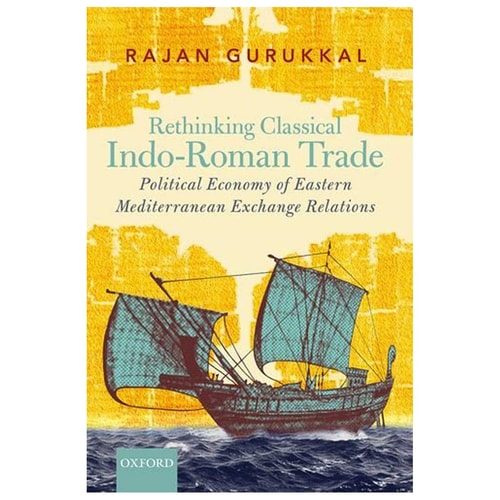
Rethinking Classical Indo-Roman Trade: Political Economy of Eastern Mediterranean Exchange Relations
0
0
As an Amazon Associate and affiliate partner, Menrva Books earns from qualifying purchases. Learn more
Author Description
The book is a critical rethinking of the nature of the classical eastern Mediterranean exchange relations with the coasts of the Indian sub-continent. It examines in the light of the extant source material and theoretical insights whether the expression aIndo a Roman tradea is tenable. The book characterizing the nature of contemporary exchanges in detail, maintains that the expression, aIndo-Roman tradea is inappropriate. It starts off with the theoretical premise that the term atradea if applies uniformly to all kinds of transactions in time and place, will lead to many anachronistic correlations, causations and generalisations about the nature of early forms of exchange.An important factor is that contemporary Mediterranean exchange of goods from the eastern world was a combination of multiple forms of exchange in which trade was just one and confined to Rome. The management of this ensemble was a heavily collaborative, extensively networked, document based, enterprise, with precise notions of weights, measures, rates of rent, interest, price and profit accounted in terms of money. It had necessitated a stratified society, aristocracy, state system and the entailing political economy of demand for luxury goods from far off lands. The book dismisses the claims in the South Indian historiography for the early historic Tamil Chieftains to have conducted overseas commerce, on the ground that such institutional and structural pre-requisites were absent in the social formations of contemporary Peninsular India. It was not possible for the merchant bodies to conduct independent overseas trade for there was no naval technology in the sub-continent efficient enough to conduct cross-oceanic voyages. There was no need for it either.
Menrva's Summary
THE THESIS
This work investigates whether the historical characterization of 'Indo-Roman trade' is an accurate description of the exchange relations between the eastern Mediterranean and the Indian subcontinent. Rajan Gurukkal, a historian specializing in South Indian social and economic history, utilizes a critical theoretical framework to challenge established historiographical narratives. By analyzing extant source materials and the structural requirements of ancient commerce, he argues that the term 'trade' is often applied anachronistically to diverse forms of exchange that lacked the necessary institutional and technological foundations in Peninsular India.
THE SCOPE MAP
What You Will Find
- Analysis of Mediterranean exchange systems and their reliance on state-level political economies.
- Critique of South Indian historiography regarding the maritime capabilities of early historic Tamil Chieftains.
- Examination of the structural prerequisites for trade, including naval technology, merchant autonomy, and monetary accounting.
- Theoretical discussion on the dangers of applying modern economic terminology to ancient social formations.
THE AUTHORITY PERSPECTIVE
Experts recognize this text as a significant contribution to the debate surrounding ancient economic history and the validity of traditional trade models. Scholars frequently note the author's rigorous application of political economy to challenge long-standing assumptions in regional historiography.
Page Count:
336
Publication Date:
2015-12-17
Publisher:
Oxford University Press
ISBN-10:
019946085X
ISBN-13:
9780199460854
Economics
History
Rome
Archaeology
Ancient History
Trade
Community Tags
Similar Books