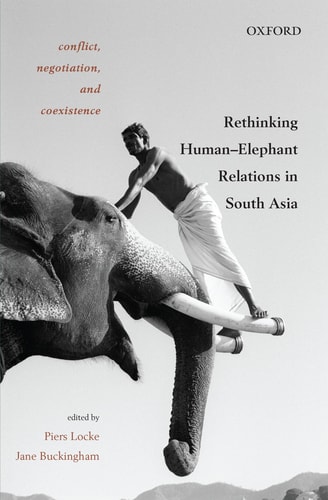
Conflict, Negotiation, and Coexistence: Rethinking Human-Elephant Relations in South Asia
0
0
As an Amazon Associate and affiliate partner, Menrva Books earns from qualifying purchases. Learn more
Author Description
As formidable instruments of war, they have changed the destinies of empires. As marauding crop raiders, they are despised. As an endangered species, they are cherished. Numerous and often contrasting are the ways in which elephants have been regarded by humans across millennia. Today, with reduced forest cover, human population expansion, and increasing industrialization, interaction between the two species is unavoidable and conflict is not mere happenstance. What, then, is the future of this relationship? In South Asia, human-elephant relationships resonate with cultural significance. From the importance of elephants in ancient texts to the role of mahouts over centuries, from discussions on de-extinction to accounts of intimate companionship, the essays in this book reveal the various dynamics of the relationship between two intelligent social mammals. Eschewing such binaries as human and animal or nature and culture, the essays present elephants as subjective agents who think, feel, and emote. Conflict, Negotiation, and Coexistence underscores the fact that we cannot understand elephant habitat and behaviour in isolation from the humans that help configure it. Significantly, nor can we understand human political, economic, and social life without the elephants that shape and share the world with them.
Menrva's Summary
THE THESIS
This collection investigates how the complex, multi-millennial relationship between humans and elephants in South Asia can be reconfigured to move beyond conflict toward sustainable coexistence. Editors Jane Buckingham and Piers Locke assemble a multidisciplinary team of scholars to challenge traditional binaries that separate nature from culture. By analyzing the elephant as a subjective agent rather than a mere resource or obstacle, the authors argue that human political and social structures are inextricably linked to the presence and behavior of these intelligent mammals.
THE SCOPE MAP
What You Will Find
- Historical analysis of elephant roles in ancient South Asian texts and imperial warfare.
- Examination of the socio-economic impact of human-elephant conflict in modern industrializing landscapes.
- Ethnographic studies regarding the traditional and evolving roles of mahouts.
- Theoretical frameworks that treat elephants as sentient, thinking, and feeling social agents.
THE AUTHORITY PERSPECTIVE
Scholars in the fields of environmental history and human-animal studies recognize this work as a significant contribution to the discourse on multispecies ethnography. The text is noted for its ability to bridge the gap between biological conservation and cultural history, providing a nuanced perspective for academic researchers and conservationists alike.
Page Count:
384
Publication Date:
2016-09-09
Publisher:
Oxford University Press
ISBN-10:
0199467226
ISBN-13:
9780199467228
Nature
History
Elephants
South Asia
Animal Studies
Human Relationships
Ecology
Anthropology
Community Tags
Similar Books