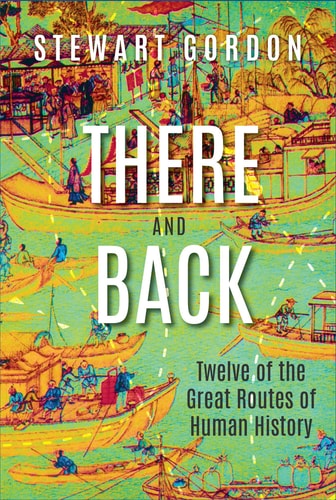
There and Back: Twelve of the Great Routes of Human History
0
0
As an Amazon Associate and affiliate partner, Menrva Books earns from qualifying purchases. Learn more
Author Description
Throughout human history, routes concentrated, funnelled, and mixed human experience. On them moved books, scrolls, and art, in addition to armies, ambassadorial entourages, slaves, brides, and pilgrims. The interaction of people on routes generated surprising innovations in ideas, religions, art, technology, and cuisine. Common themes appear repeatedly, such as slavery, piracy, government taxation and control, medicinal plants, military expeditions, the interaction of competing religions, processing of goods along the way, and networks of credit, trust, and information that often spanned continents.This book is divided into four seconds, each concentrating on a type of route: river, pilgrimage, tribute, and trade. The arrangement is based on cognitive geography, rather than technological or physical similarities. For instance, the Rhine is not a river route because there is water flowing between two banks, but because of the songs and fairy tales about it and its long history as a political boundary. Pilgrimage routes are grounded in shared expectations and experiences, just as routes of imperial tribute rest primarily on the expectations of local officials, transporters, and military guards. Trade routes foreground the expectations of professional traders. Each route is 'travelled' through the memoir of a real traveller, pulling away to address larger issues, but never losing the engagement of the human story.The geographic reach is worldwide with chapters, for example, on the Grand Canal of China and the Inca road system; they also have considerable historical depth, from the ancient Nile to the Erie Canal and the modern Hajj.
Menrva's Summary
THE THESIS
This book investigates how historical routes functioned as conduits for the exchange of ideas, goods, and cultural practices that shaped human civilization. Stewart Gordon, a historian specializing in South Asian history, utilizes a cognitive geography framework to analyze twelve distinct routes. By anchoring each chapter in the memoir of a historical traveler, he argues that these paths were defined more by human expectation and social interaction than by their physical geography.
THE SCOPE MAP
What You Will Find
- Analysis of four distinct route categories: river, pilgrimage, tribute, and trade.
- Case studies ranging from the ancient Nile and the Grand Canal of China to the Inca road system and the modern Hajj.
- A methodology that pairs individual human narratives with broader historical and economic analysis.
- Examination of recurring themes including taxation, religious exchange, credit networks, and the movement of medicinal goods.
THE AUTHORITY PERSPECTIVE
Scholars and readers appreciate the book for its innovative approach to historical geography, which prioritizes human experience over mere physical mapping. The text is noted for its accessible prose and its ability to synthesize complex historical data into a coherent, narrative-driven format.
Page Count:
288
Publication Date:
2018-05-15
Publisher:
Oxford University Press
ISBN-10:
0199476454
ISBN-13:
9780199476459
Politics
History
Travel
India
Social Science
Kindle Store
Asia
Categories
Human beings
Geography
Kindle eBooks
Transportation
Cultural History
Community Tags
Similar Books