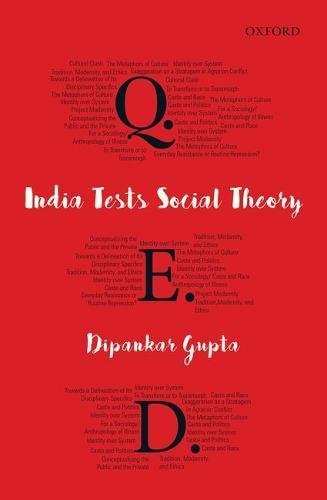
Q.E.D.: India Tests Social Theory
0
0
As an Amazon Associate and affiliate partner, Menrva Books earns from qualifying purchases. Learn more
Author Description
Sociology in India has remained dominated by its unique epistemological location - which has acted as both a boon and a bane. Entanglement with the exotic has prevented Indian sociologists and the so-called 'India' experts, from contributing constructively to theory building at a universal level. Buttressing the importance of theory-building as a critical requirement for social sciences to grow - in terms of the capacity to explain the particular via the general and vice versa - this book emphasizes the criticality of engaging with Indian data and generalizations at a theoretical level, and makes a plea for intersubjectivity and comparative sociology. Taking up unresolved theoretical issues in the field of health, agricultural unrest, caste, and the understanding of modernity, the author's introduction and essays compiled in this volume show how the failure of Indianists to forego the isolating position of uniqueness of Indian reality, has led to, on one hand, further strengthening of the dominance of western models, and rise of untenable and incomplete conceptualization of modernity and modern knowledge, on the other.
Menrva's Summary
THE THESIS
This book investigates the failure of Indian sociology to contribute to universal social theory due to an over-reliance on the perceived uniqueness of Indian reality. Author Dipankar Gupta, a prominent sociologist, argues that the field has become trapped in an exoticized framework that hinders constructive theoretical growth. By analyzing specific case studies, Gupta advocates for a comparative approach that bridges the gap between local data and generalizable social science concepts.
THE SCOPE MAP
What You Will Find
- Critical analysis of the epistemological isolation of Indian sociology.
- Theoretical examinations of health, agricultural unrest, and caste systems.
- Arguments for intersubjectivity and comparative methodology in social research.
- Critique of the dominance of Western models in interpreting modernity.
THE AUTHORITY PERSPECTIVE
Experts recognize this work as a significant intervention in the discourse on post-colonial social science methodology. Readers frequently note the academic density of the prose and the author's rigorous challenge to established disciplinary norms.
Page Count:
240
Publication Date:
2018-08-21
Publisher:
Oxford University Press
ISBN-10:
0199476519
ISBN-13:
9780199476510
Theory
Modernity
India
Social Science
Sociology
Caste
Community Tags
Similar Books