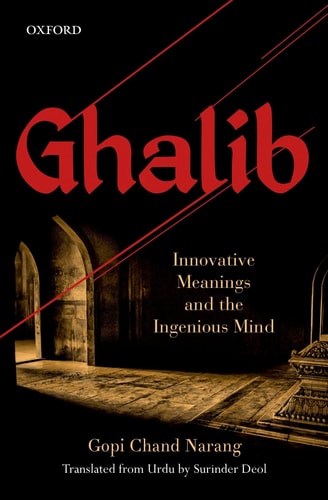
Ghalib: Innovative Meanings and the Ingenious Mind
0
0
As an Amazon Associate and affiliate partner, Menrva Books earns from qualifying purchases. Learn more
Author Description
Interpretations of Mirza Ghalib's works have been changing with the times. Romantics, classicists, progressives, and modernists, all have found evidence in his writings that appeared close to their viewpoints.This work studies the ingenious poetics of Ghalib by tracing the roots of his creative consciousness and enigmatic thought in Buddhist dialectical philosophy, in particular in Nagarjuna's concept ofshunyata(emptiness or voidness). The author also underscores the importance of the Sabke Hindi tradition, that is, the Indian style of Mughal Persian poetry with indigenized poetics, especially through Abdul-Qadir Bedil, whom Ghalib considered his mentor. He contends that Ghalib reinvented and polished this tradition deploying the dialectical mode and the language of silence he mastered through his understanding of the ancient philosophy of India under the influence of his mentor Bedil of the Sabke Hindi tradition. Creativity is a complex matter where nothing is cut numerically to the preconceived notions. The charm of love poetry of Ghalib comes from his complexity and ingenuity. This has been established through the study in this book that makes it exciting and revealing. Gopi Chand Narang engages with Ghalib criticism that has flourished since his death and analyses the important works of the poet, including pieces from earlyNuskhas andDivan-e Ghalib, using this central argument.
Menrva's Summary
THE THESIS
This work investigates the core question of how Mirza Ghalib’s creative consciousness and enigmatic poetic thought were shaped by Buddhist dialectical philosophy and the Sabke Hindi tradition. Prof. Gopi Chand Narang, a distinguished scholar of Urdu literature, utilizes a rigorous analytical framework to trace the influence of Nagarjuna’s concept of shunyata on Ghalib’s work. By examining the poet's intellectual lineage and his connection to Abdul-Qadir Bedil, the author argues that Ghalib’s ingenuity stems from a sophisticated synthesis of Indian philosophy and Persian poetic styles. The text provides a scholarly re-evaluation of Ghalib’s verse, moving beyond traditional romantic or modernist interpretations to uncover the structural complexity of his language.
THE SCOPE MAP
What You Will Find
- Analysis of Buddhist dialectical philosophy, specifically the concept of shunyata, within Ghalib’s poetry.
- Examination of the Sabke Hindi tradition and the influence of Abdul-Qadir Bedil on Ghalib’s creative development.
- Comparative study of early Nuskhas and the Divan-e Ghalib to illustrate the evolution of the poet’s thought.
- Critical synthesis of historical Ghalib scholarship, ranging from classicist to modernist perspectives.
THE AUTHORITY PERSPECTIVE
Scholars and critics recognize this work as a significant contribution to the study of Urdu literature, particularly for its focus on the philosophical underpinnings of Ghalib’s verse. Readers frequently note the academic density of the prose, which requires a foundational understanding of both Persian poetic traditions and Indian philosophical concepts.
Page Count:
464
Publication Date:
2017-12-06
Publisher:
Oxford University Press
ISBN-10:
0199475911
ISBN-13:
9780199475919
Biography
Philosophy
Poetry
Kindle Store
Kindle eBooks
Literary Criticism
Asian Studies
Categories
Criticism & Theory
Criticism history
Community Tags
Similar Books