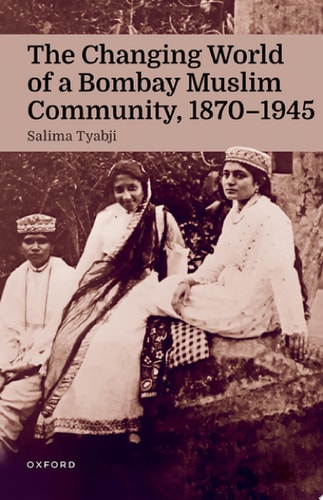
The Changing World of a Bombay Muslim Community, 1870-1945
0
0
As an Amazon Associate and affiliate partner, Menrva Books earns from qualifying purchases. Learn more
Author Description
Muslims formed a disparate and unwieldy community in Bombay in the nineteenth century. The Islam that was professedly held in common by various groups could barely provide a sense of unity or cohesion to people so widely diverse in terms of language, customs, and also of forms and practices of belief. By the middle of the nineteenth century, a class of wealthy ship owners, ship-builders, and merchants, belonging to the varied communities that constituted the city, of which Muslims formed an important part, had emerged. This class was outward-looking, modern, and generally reformist in outlook: Gujarati or Maharashtrian, its goals of social reform, education, as well as political awareness, were gradually beginning to be perceived as goals held across communities, and increasingly across different regions. The questions that were being raised in the social turmoil of the period amongst Hindus were over issues of female education, the age of marriage, widow remarriage, and female seclusion. These issues were not foreign to the Muslim community; and the part played by Muslim leaders in Bombay in discussing and negotiating them was not an insignificant one, taking into account the size and relative backwardness of the community. Within this context, this book traces the evolving identity of a Bombay family and its changing social and political views in the late nineteenth and early twentieth centuries, using three main sources: their family journals, an individual memoir/journal, and letters written home from Europe.
Menrva's Summary
THE THESIS
This work investigates how a specific Bombay Muslim family navigated the intersection of traditional identity and modern social reform between 1870 and 1945. Salima Tyabji utilizes a micro-historical approach to examine how a wealthy, merchant-class family adapted to the shifting political and social landscape of colonial India. By analyzing private documents, the author demonstrates how internal family dynamics mirrored broader regional debates regarding education, gender roles, and political consciousness.
THE SCOPE MAP
What You Will Find
- Analysis of social reform movements including female education and marriage customs.
- Examination of the transition from traditional merchant practices to modern political engagement.
- Primary source material derived from family journals, personal memoirs, and correspondence from Europe.
Scope Limits
- The study focuses primarily on a specific elite family and may not represent the experiences of the broader, more diverse Muslim population of Bombay.
- The analysis is constrained by the availability and perspective of the private documents utilized.
THE AUTHORITY PERSPECTIVE
Scholars recognize this text as a valuable contribution to the study of colonial urban history and the internal evolution of Indian Muslim identity. Readers often note the academic rigor of the research and the clarity with which the author contextualizes private family narratives within the larger framework of Indian social history.
Page Count:
358
Publication Date:
2024-01-01
Publisher:
Oxford University Press
ISBN-10:
0192869744
ISBN-13:
9780192869746
Biography
History
Asia
Educational Resources
Muslim History
Sociology
Asian Studies
Community Tags
Similar Books