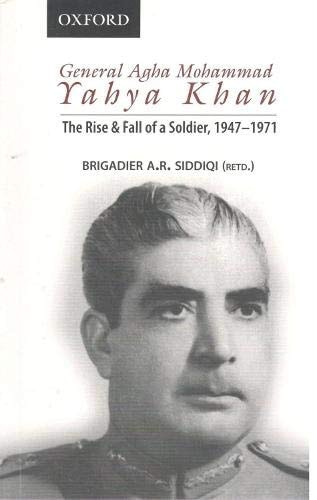
General Agha Mohammad Yahya Khan: The Rise and Fall of a Soldier, 1947-1971
0
0
As an Amazon Associate and affiliate partner, Menrva Books earns from qualifying purchases. Learn more
Author Description
Although this book is about General Yahya Khan’s personal trajectory in the Pakistan Army, yet it most importantly offers a historical insight into key political events from 1947 to 1971. The author, popularly regarded as Yahya Khan’s important PR-man, throws new light on the 1965 war and the still mysterious change in command in mid-offensive during that war; Yahya Khan’s take-over of power from Field Marshal Mohammad Ayub Khan; army action and surrender in East Pakistan, and other issues considered contentious to-date. Moreover, this book offers an analysis on the Pakistan Army’s ideological positioning—in its Introduction, ‘The Pakistan Army and an Anatomy of Jihad’—throughout these years which help us understand the nature of armed conflicts within and without, the infiltration of the jihadi ethos against conventional professionalism of the army, as protectors of the homeland. While most of the failings in the higher military and political command and that of the civil servants and politicians, of that time are well-known, and covered in a number of retrospective books, memoirs, and the Hamoodur Rehman Commission Report, this book holistically questions and analyses those alleged failings since the author presents his first-hand, objective account as a witness to essential developments in 1965 and 1971 wars and the events leading to both periods. Therefore, as an former Army PRO, Brigadier Siddiqi’s is an inside account and he does not hesitate to speak his mind.
Menrva's Summary
THE THESIS
This work investigates the military career and political tenure of General Agha Mohammad Yahya Khan to determine how his leadership and the shifting ideological framework of the Pakistan Army influenced the nation's trajectory between 1947 and 1971. The author, Brigadier A.R. Siddiqi, utilizes his unique position as a former Army Public Relations officer to provide an insider’s perspective on critical historical junctures. By examining the transition of power from Ayub Khan and the internal dynamics of the 1965 and 1971 wars, the text seeks to clarify the institutional failures and ideological shifts that defined this period of Pakistani history.
THE SCOPE MAP
What You Will Find
- Analysis of the 1965 Indo-Pakistani War and the mid-offensive command changes.
- Examination of the transition of power from Field Marshal Ayub Khan to Yahya Khan.
- Evaluation of the Pakistan Army’s ideological evolution and the infiltration of jihadi ethos.
- First-hand observations regarding the military and political collapse in East Pakistan.
Scope Limits
- The book does not provide a comprehensive biography of Yahya Khan’s early life outside of his military career.
- It does not attempt to replace official government records or the Hamoodur Rehman Commission Report but rather offers a supplementary personal account.
THE AUTHORITY PERSPECTIVE
Experts and historians recognize this work as a significant primary source due to the author's direct proximity to the military high command during the period in question. Readers frequently note that the prose provides a candid, albeit subjective, critique of the institutional failures that characterized the Pakistani military establishment during the late 1960s and early 1970s.
Page Count:
204
Publication Date:
2020-01-01
Publisher:
OUP
ISBN-10:
0190701412
ISBN-13:
9780190701413
Biography
Military History
Political History
Asia history
Asian Studies
Community Tags
Similar Books