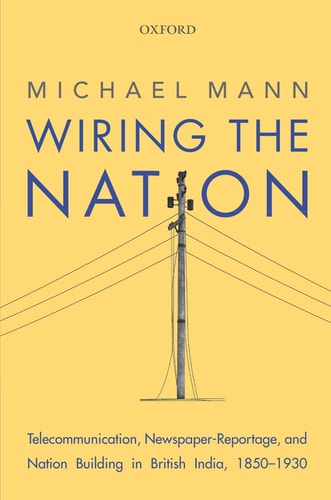
Wiring the Nation: Telecommunication, Newspaper-Reportage, and Nation Building in British India, 1850-1930
0
0
As an Amazon Associate and affiliate partner, Menrva Books earns from qualifying purchases. Learn more
Author Description
News today is understood as the most recent information available from places all over the world. It was the telegraph which gave birth to this understanding by profoundly transforming the global press landscape at the turn of the nineteenth century. Select information bought from agencies like Reuters, Wolff, Havas, and Associated Press made their way into newspapers--'news' became a commodity and journalism as we know it was born.In British India, after the Great Rebellion of 1857-8 and with the end of the Mughal dynasty, the concept of a shared cultural community was lost. In the decades that followed, telegraphically disseminated news played a leading role in shaping an all-India public sphere, in the process resurrecting the idea of a unified nation--an idea that formed the basis of the anti-colonial struggle launched soon after.As Wiring the Nation traces the social, cultural, and political consequences of the telegraph in colonial India, this new mode of communication emerges not merely as a technological marvel, but also as a force with the power to influence the imagination of an entire nation.
Menrva's Summary
THE THESIS
How did the introduction of telegraphic communication fundamentally reshape the political and cultural landscape of colonial India between 1850 and 1930? Michael Mann, a historian specializing in South Asian colonial history, examines the intersection of technological infrastructure and the emergence of a unified national identity. By analyzing the shift from localized information to standardized, agency-driven news, the author argues that the telegraph served as a critical instrument for the British colonial administration while simultaneously providing the tools for anti-colonial movements to construct an all-India public sphere.
THE SCOPE MAP
What You Will Find
- Analysis of the telegraph's role in post-1857 British Indian administrative consolidation.
- Examination of the influence of international news agencies like Reuters and Havas on local journalism.
- Historical investigation into the transition of news from a localized commodity to a standardized national product.
- Exploration of how communication networks facilitated the development of anti-colonial political consciousness.
THE AUTHORITY PERSPECTIVE
Scholars in the field of colonial studies and media history recognize this work as a rigorous examination of the sociopolitical impact of infrastructure in British India. Readers frequently note the academic density of the prose and the extensive use of archival evidence to support the author's claims regarding nation-building.
Page Count:
324
Publication Date:
2017-04-16
Publisher:
Oxford University Press
ISBN-10:
0199472173
ISBN-13:
9780199472178
History
Journalism
Reporters and reporting
Colonial History
Communication
India
Technology
Community Tags
Similar Books