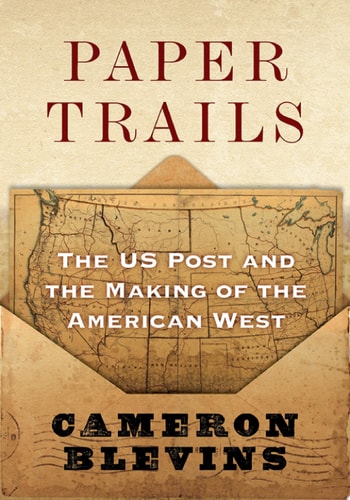
Paper Trails: The US Post and the Making of the American West
0
0
As an Amazon Associate and affiliate partner, Menrva Books earns from qualifying purchases. Learn more
Author Description
A groundbreaking history of how the US Post made the nineteenth-century American West.There were five times as many post offices in the United States in 1899 than there are McDonald's restaurants today. During an era of supposedly limited federal government, the United States operated the most expansive national postal system in the world.In this cutting-edge interpretation of the late nineteenth-century United States, Cameron Blevins argues that the US Post wove together two of the era's defining projects: western expansion and the growth of state power. Between the 1860s and the early 1900s, the western United States underwent a truly dramatic reorganization of people, land, capital, and resources. It had taken Anglo-Americans the better part of two hundred years to occupy the eastern half of the continent, yet they occupied the West within a single generation. As millions of settlers moved into the region, they relied on letters and newspapers, magazines and pamphlets, petitions and money orders to stay connected to the wider world.Paper Trails maps the spread of the US Post using a dataset of more than 100,000 post offices, revealing a new picture of the federal government in the West. The western postal network bore little resemblance to the civil service bureaucracies typically associated with government institutions. Instead, the US Post grafted public mail service onto private businesses, contracting with stagecoach companies to carry the mail and paying local merchants to distribute letters from their stores. These arrangements allowed the US Post to rapidly spin out a vast and ephemeral web of postal infrastructure to thousands of distant places.The postal network's sprawling geography and localized operations forces a reconsideration of the American state, its history, and the ways in which it exercised power.
Menrva's Summary
THE THESIS
Cameron Blevins investigates how the United States Post Office served as the primary instrument for federal expansion and state-building in the American West during the late nineteenth century. Blevins, a historian specializing in the American West and digital history, utilizes a massive dataset of over 100,000 post office locations to challenge the notion of a weak or absent federal government during this period. He argues that the postal system functioned as a decentralized, hybrid network that integrated private enterprise with public service to facilitate rapid territorial occupation and integration.
THE SCOPE MAP
What You Will Find
- A comprehensive analysis of the US postal network between the 1860s and the early 1900s.
- An examination of the intersection between private business contracts and federal infrastructure.
- Quantitative data mapping the rapid expansion of postal services across the western frontier.
Scope Limits
- The study focuses primarily on the late nineteenth-century period and does not provide an exhaustive history of the US Post from its inception to the present day.
THE AUTHORITY PERSPECTIVE
Historians and scholars of the American West frequently cite this work for its innovative use of digital mapping and data visualization to reframe traditional narratives of federal power. Experts highlight the text as a significant contribution to the study of state-building and the logistical realities of frontier expansion.
Page Count:
248
Publication Date:
2021-04-01
Publisher:
Oxford University Press
ISBN-10:
0190053674
ISBN-13:
9780190053673
History
Politics
American History
Social History
Communication Studies
Historical geography
Infrastructure
United States
Americas
Introduction to Human Communication
Political History
Words Language & Grammar
Government
Communication
New Used & Rental Textbooks
Reference
Community Tags
Similar Books