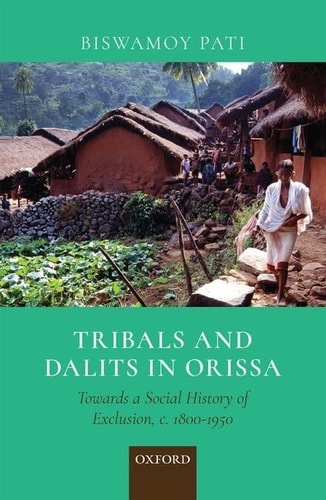
Tribals and Dalits in Orissa: Towards a Social History of Exclusion, c. 1800-1950
0
0
As an Amazon Associate and affiliate partner, Menrva Books earns from qualifying purchases. Learn more
Author Description
This book examines diverse aspects of the social history of the tribals and dalits/outcastes in Orissa. It delineates how the socially excluded sections were further impoverished by both colonial government policies and the chiefs of the despotic princely states who worked in tandem with the colonizers.In the book, Biswamoy Pati studied several key issues including 'colonial knowledge' systems, the stereotyping of tribals as violent and brutal, and colonial constructions of the 'criminal tribe'. Additionally examined are colonial agrarian settlements, adivasi strategies of resistance, (including uprisings); indigenous systems of health and medicine; the colonial 'medical gaze;' conversion (to Hinduism); fluidities of caste formations in the nineteenth century; the appropriation by princely rulers of adivasi deities and healing methods; the rituals of legitimacy adopted by these rulers; as well as the development of colonial capitalism and urbanization. Also explored are the connections between marginalized groups and the national movement, and the way these inherited problems have remained unresolved after Independence.Drawing upon archival and rare sources, this important book would interest the general reader, besides students of history, social anthropology, political sociology, cultural studies, dalit studies, social exclusion, and the social history of medicine. It would also attract NGOs and planners of public policy.
Menrva's Summary
THE THESIS
This work investigates the systemic mechanisms of social exclusion and economic marginalization faced by tribal and Dalit populations in Orissa between 1800 and 1950. Biswamoy Pati, a historian specializing in modern Indian history, utilizes a vast array of archival records and rare primary sources to analyze the intersection of colonial governance and local princely rule. The text argues that the convergence of colonial administrative policies and despotic regional leadership systematically impoverished these groups while constructing enduring stereotypes that persist into the post-Independence era.
THE SCOPE MAP
What You Will Find
- Analysis of colonial knowledge systems and the construction of the 'criminal tribe' archetype.
- Examination of agrarian settlements, colonial capitalism, and the impact of urbanization on indigenous communities.
- Documentation of adivasi resistance strategies and uprisings against colonial and princely authority.
- Investigation into the colonial medical gaze, indigenous health systems, and the appropriation of adivasi deities by ruling elites.
THE AUTHORITY PERSPECTIVE
Scholars and students of social history and political sociology identify this text as a rigorous examination of marginalized identities within the context of Indian colonial history. Experts frequently note the density of the archival research and the clarity with which the author connects historical exclusion to contemporary social challenges.
Page Count:
248
Publication Date:
2019-03-17
Publisher:
Oxford University Press
ISBN-10:
0199489408
ISBN-13:
9780199489404
History
Tribes
Anthropology
Sociology
Colonialism
India
Social History
Dalits
Dalit Studies
Community Tags
Similar Books