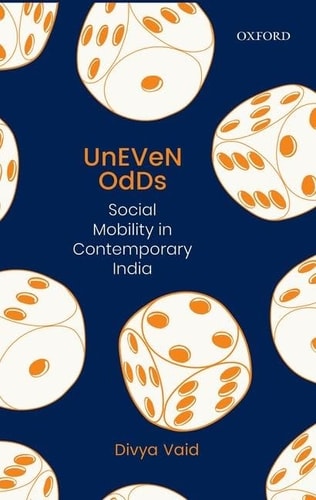
Uneven Odds: Social Mobility in Contemporary India
0
0
As an Amazon Associate and affiliate partner, Menrva Books earns from qualifying purchases. Learn more
Author Description
Social mobility research has held a central place in the sociological analysis of industrialized countries of the west, particularly with regard to the study of stratification systems, their forms, and processes. The research on India has however been mostly scattered. The lack of systematic research in this area implies that we do not have a sense of the precise amount of social mobility in contemporary India, and the changes such mobility has had on social structures over time and across demographics. This book draws on national level datasets and quantitative methods to understand the multiple strands of social mobility or the lack of it, by focusing on the overlapping identities of social class, caste, and gender in both rural and urban context. It investigates the contemporary processes and drivers of mobility, and appraises the role of education in supporting or preventing increased upward social mobility by concentrating on those groups that are disadvantaged from this very opportunity. It also takes into account the impact of liberalization on social mobility and argues that mobility today is differentially patterned on the basis of local and global identities.
Menrva's Summary
THE THESIS
This book investigates the extent and nature of social mobility in contemporary India by analyzing how class, caste, and gender intersect to influence individual life chances. Divya Vaid, a sociologist specializing in social stratification, utilizes rigorous quantitative methods and national-level datasets to address the lack of systematic research in this field. The work argues that social mobility in India is not uniform but is instead shaped by the complex interplay of historical social structures and the modern pressures of economic liberalization.
THE SCOPE MAP
What You Will Find
- Quantitative analysis of national-level datasets to measure social mobility trends.
- Examination of the intersectional impact of caste, class, and gender on life outcomes.
- Assessment of the role of education as both a facilitator and a barrier to upward mobility.
- Comparative study of mobility patterns across both rural and urban Indian demographics.
THE AUTHORITY PERSPECTIVE
Experts recognize this work as a significant contribution to the sociological study of Indian stratification due to its empirical rigor. Readers frequently note the academic density of the prose, making it a foundational text for scholars interested in the intersection of economic policy and social identity in South Asia.
Page Count:
356
Publication Date:
2018-07-20
Publisher:
Oxford University Press
ISBN-10:
0199480141
ISBN-13:
9780199480142
Politics
Economics
Social Science
Kindle Store
Family relationships
Abuse
Categories
Race Relations
Kindle eBooks
India
Education
Sociology
Community Tags
Similar Books