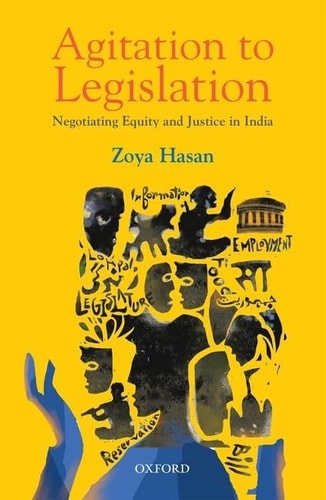
Agitation to Legislation: Negotiating Equity and Justice in India
0
0
As an Amazon Associate and affiliate partner, Menrva Books earns from qualifying purchases. Learn more
Author Description
The book examines (1) the relationship between political mobilization and the making of policy/ to grant socio-economic rights (2) the creation of institutions and (3) representation in public institutions i.e. legislatures. It investigates the relationship of political mobilization, party strategies and policy change to understand how campaigns and agitations organized by actors outside traditional electoral networks interact with established political actors to influence the making of social policy and legislations in India in the broader frame of democratic politics.The central question is in what circumstances is social and political mobilization to claim rights and entitlements or the demand for accountability or greater representation in legislatures responded to and addressed to by the state. This is done through an analusis of three empirical cases: (1) Right to employment and Right to food; (2) The anti-corruption or Lokpal or movement, (3) Legislative reservations for women. All but one resulted in legislation. These three cases cover recurring themes in the sphere of political mobilization and the claims they make for redistribution, accountability and representation.By focusing on political actors and processes that shape various legislations to expand rights, accountability and representation, the book argues that it is principally the political context, party processes and leadership strategies that influenced policy decisions of the government. Taken together, the arguments advanced here underlines the social and political implications of situations where both state and mobilization campaigns are the agents and loci of dominance, resistance, and critique. Outcomes are contingent on political responses and party strategies which are an important element of the underlying dynamics, and not merely the scale and intensity of public protest and collective action.
Menrva's Summary
THE THESIS
This book investigates the conditions under which political mobilization and public agitation successfully influence state policy and legislative outcomes in India. Zoya Hasan, a prominent political scientist, utilizes a framework centered on party strategies, political context, and leadership decision-making to explain why some social movements result in policy change while others do not. By analyzing the interplay between grassroots activism and institutional power, the author argues that legislative success is contingent upon the strategic responses of political actors rather than the mere intensity of public protest.
THE SCOPE MAP
What You Will Find
- Analysis of three distinct empirical case studies: the Right to Employment and Food, the anti-corruption Lokpal movement, and legislative reservations for women.
- An examination of the relationship between political mobilization, party strategies, and the creation of socio-economic rights.
- A study of representation and accountability within public institutions and legislatures.
- A theoretical framework for understanding how non-electoral actors interact with the state to shape democratic policy.
THE AUTHORITY PERSPECTIVE
Experts in South Asian politics identify this work as a significant contribution to the study of democratic processes and state-society relations in India. Readers frequently note the clarity with which the author navigates complex political dynamics to provide a structured analysis of legislative change.
Page Count:
280
Publication Date:
2018-09-15
Publisher:
Oxford University Press
ISBN-10:
0199482179
ISBN-13:
9780199482177
Politics
India
Kindle eBooks
Kindle Store
Categories
Elections & Political Process
Public Policy
Government
Sociology
World politics
Community Tags
Similar Books