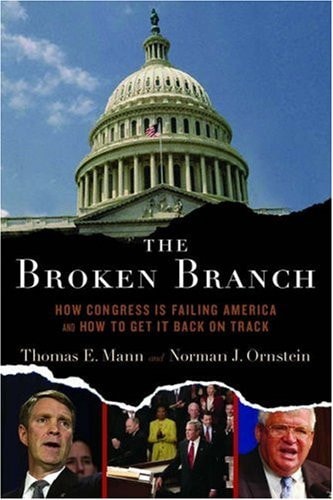
The Broken Branch: How Congress Is Failing America and How to Get It Back on Track
0
0
As an Amazon Associate and affiliate partner, Menrva Books earns from qualifying purchases. Learn more
Author Description
Congress is the first branch of government in the American system, write Thomas E. Mann and Norman J. Ornstein, but now it is a broken branch, damaged by partisan bickering and internal rancor. The Broken Branch offers both a brilliant diagnosis of the cause of Congressional decline and a much-needed blueprint for change, from two experts who understand politics and revere our institutions, but believe that Congress has become deeply dysfunctional.Mann and Ornstein, two of the nations most renowned and judicious scholars of government and politics, bring to light the historical roots of Congress's current maladies, examining 40 years of uninterrupted Democratic control of the House and the stunning midterm election victory of 1994 that propelled Republicans into the majority in both House and Senate. The byproduct of that long and grueling but ultimately successful Republican campaign, the authors reveal, was a weakened institution bitterly divided between the parties. They highlight the dramatic shift in Congress from a highly decentralized, committee-based institution into a much more regimented one in which party increasingly trumps committee. The resultant changes in the policy process--the demise of regular order, the decline of deliberation, and the weakening of our system of checks and balances--have all compromised the role of Congress in the American Constitutional system. Indeed, Speaker Dennis Hastert has unabashedly stated that his primary responsibility is to pass the president's legislative program--identifying himself more as a lieutenant of the president than a steward of the house. From tax cuts to the war against Saddam Hussein to a Medicare prescription drug benefit, the legislative process has been bent to serve immediate presidential interests and have often resulted in poorly crafted and stealthily passed laws. Strong majority leadership in Congress, the authors conclude, led not to a vigorous exertion of congressional authority but to a genera
Menrva's Summary
THE THESIS
This book investigates the systemic decline of the United States Congress, questioning how partisan polarization and institutional shifts have compromised its constitutional role as a co-equal branch of government. Authors Norman J. Ornstein and Thomas E. Mann, both distinguished scholars of American politics, utilize decades of legislative observation and historical analysis to argue that Congress has abandoned its deliberative functions in favor of rigid party loyalty. They present a framework that traces the erosion of committee power and the rise of executive-centric legislative processes, ultimately proposing structural reforms to restore institutional integrity.
THE SCOPE MAP
What You Will Find
- Historical analysis of the forty-year period of Democratic control in the House.
- Examination of the 1994 midterm elections and the subsequent shift in legislative culture.
- Case studies on major policy enactments, including tax legislation and the Medicare prescription drug benefit.
- A proposed blueprint for institutional reform to restore checks and balances.
THE AUTHORITY PERSPECTIVE
Experts and political scientists frequently cite this work as a foundational text for understanding the modern transformation of the legislative branch. Readers often note the dense, scholarly nature of the prose, which provides a rigorous examination of procedural changes within the House and Senate.
Page Count:
288
Publication Date:
2006-08-01
Publisher:
Oxford University Press
ISBN-10:
0195174461
ISBN-13:
9780195174465
Politics
History
Americas
Elections & Political Process
Kindle eBooks
United States
Kindle Store
Specific Topics
Categories
Government
Community Tags
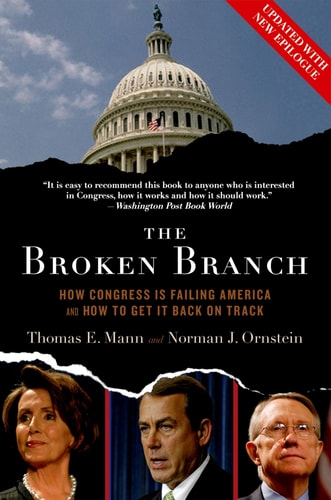
Other Editions(2)
Similar Books







Reader Comments
Share Your Thoughts
No comments yet. Be the first to share your thoughts!