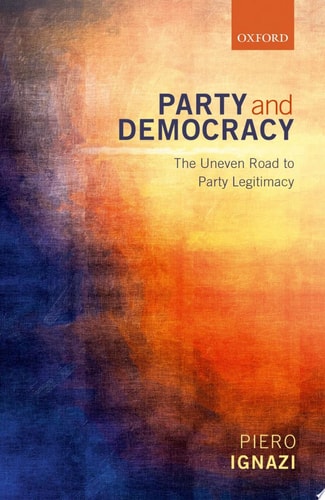
Party and Democracy: The Uneven Road to Party Legitimacy
0
0
As an Amazon Associate and affiliate partner, Menrva Books earns from qualifying purchases. Learn more
Author Description
Party and Democracy questions why political parties today are held in such low estimation in advanced democracies. The first part of the volume reviews theoretical motivations behind the growing disdain for the political party. In surveying the parties' lengthy attempt to gain legitimacy, particular attention is devoted to the cultural and political conditions which led to their emergence on the ground' and then to their political and theoretical acceptance as the sole master in the chain of delegation. The second part traces the evolution of the party's organization and public confidence against the backdrop of the transition from industrial to post-industrial societies. The book suggests that, in the post-war period, parties shifted from a golden age of organizational development and positive reception by public opinion towards a more difficult relationship with society as it moved into post industrialism. Parties were unable to master societal change and thus moved towards the state to recover resources they were no longer able to extract from their constituencies. Parties have become richer and more powerful thanks to their interpenetration into the state, but they have paid' for their pervasive presence in society and the state with a declining legitimacy. Even if some changes have been introduced recently in party organizations to counteract their decline, they seem to have become ineffective; even worse, they have dampened democratic standing inside and outside parties, favouring plebiscitary tendencies. The party today is caught in a dramatic contradiction. It has become a sort of Leviathan with clay feet: very powerful thanks to the resources it gets from the state and to its control of the societal and state spheres, but very weak in terms of legitimacy and confidence in the eyes of the mass public. However, it is argued that there is still no alternative to the party. Democracy is still inextricably linked to the party system.
Menrva's Summary
THE THESIS
This work investigates the paradox of why political parties in advanced democracies possess significant state power while simultaneously suffering from a profound crisis of public legitimacy. Piero Ignazi, a scholar of comparative politics, utilizes historical analysis and organizational theory to examine the evolution of party structures. He argues that the transition from industrial to post-industrial society forced parties to rely on state resources rather than constituent support, leading to a disconnect between institutional strength and public trust.
THE SCOPE MAP
What You Will Find
- Historical analysis of party development from the industrial era to post-industrialism
- Theoretical framework regarding the chain of delegation in democratic systems
- Examination of the shift from constituent-based funding to state-dependent resource extraction
- Analysis of the 'Leviathan with clay feet' phenomenon in modern governance
Scope Limits
- The analysis focuses primarily on advanced Western democracies rather than developing political systems
- The text does not provide specific policy prescriptions for reforming party structures
THE AUTHORITY PERSPECTIVE
Experts recognize this volume as a rigorous contribution to the study of party institutionalization and democratic decline. Readers frequently note the academic density of the prose, which is best suited for students and scholars of political science.
Page Count:
352
Publication Date:
2017-01-01
Publisher:
OUP Oxford
ISBN-10:
0191054720
ISBN-13:
9780191054723
Politics
Categories
Democracy
Government
Kindle eBooks
Sociology
Systems Theory
Public Policy
Elections & Political Process
Kindle Store
World politics