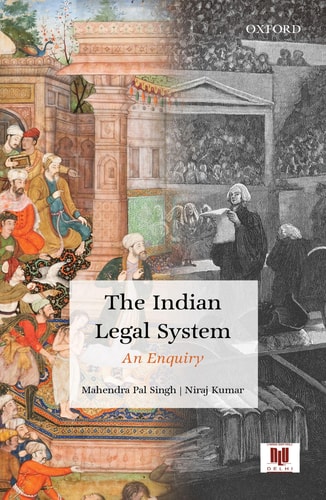
The Indian Legal System: An Enquiry
0
0
As an Amazon Associate and affiliate partner, Menrva Books earns from qualifying purchases. Learn more
Author Description
Legal, anthropological, and historical literature acknowledges the undisputed presence of multiple legal traditions in India. However, the existence of uniform laws applicable to all citizens, questions plurality at some levels. The existence of multiple non-state legal traditions alongside a proclaimed formal state legal system certainly poses a challenge to the common law identity of the Indian legal system. It is historically acknowledged that colonialism and law share a reciprocal relationship, where law was used for the expansion of colonial rule, and was not an accurate reflection of the needs of society. When common law was introduced in India by the British to better integrate the Indian legal system, they did not refer to the prevailing legal practices of the time. Neither was it an exact appropriation of common law as understood in England. The book argues that this is the underlying cause for the gap between the state legal system and traditional community practices. This is arguably the reason behind preference for non-state legal practices among several communities in India, despite the existence of a formal state legal system. The central theme of the book is that legal systems cannot be seen or studied in isolation of the cultures of groups whose affairs they regulate.
Menrva's Summary
THE THESIS
This book investigates the fundamental tension between the formal state-mandated legal system in India and the persistent, diverse non-state legal traditions that continue to govern community life. Authors Mahendra Pal Singh and Niraj Kumar utilize historical analysis and legal theory to argue that the imposition of British common law failed to account for indigenous social practices, resulting in a persistent disconnect between state law and societal needs. The text examines how colonial legal frameworks were imported without integration into existing cultural norms, creating a dualistic system that remains unresolved in contemporary India.
THE SCOPE MAP
What You Will Find
- Historical analysis of the introduction of British common law in India.
- Examination of the reciprocal relationship between colonial expansion and legal codification.
- Comparative study of state-sanctioned legal frameworks versus traditional community-based legal practices.
- Theoretical framework regarding the necessity of studying legal systems within their specific cultural contexts.
THE AUTHORITY PERSPECTIVE
Legal scholars and historians recognize this work as a critical contribution to the study of legal pluralism in post-colonial societies. The text is frequently cited for its rigorous academic approach to the historical origins of the gap between formal state law and local community practices.
Page Count:
240
Publication Date:
2019-05-28
Publisher:
Oxford University Press
ISBN-10:
0199489874
ISBN-13:
9780199489879
History
Law india
Sociology
Legal Studies
Law
Colonies
India
Community Tags
Similar Books