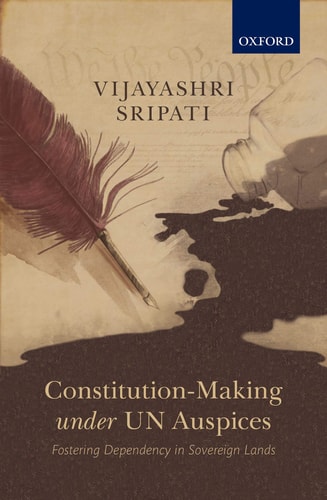
Constitution-Making under UN Auspices: Fostering Dependency in Sovereign Lands
0
0
As an Amazon Associate and affiliate partner, Menrva Books earns from qualifying purchases. Learn more
Author Description
This book raises very interesting and important questions about the legitimacy of the contemporary use of United Nations Constitutional Assistance (UNCA) (1989-2018) which birthed in 1949, as trusteeship and was, for this reason, rejected in 1960. Conceptual confusions have turned scholars' and policymakers' attention away from the Western liberal constitution that UNCA internationalizes.The Constitution's salience makes UNCA the most significant post-1989 development---one that promotes the 'rule of law,' provides the basis for UN/ international territorial administration, and shapes all other developments. During colonialism, foreign states and international organizations starting from the League of Nations, followed by the United Nations, internationalized the Constitution in response to the colonies' supposed incapacities, and ostensibly to promote free markets, rule of law, good governance and civilized standards concerning women, with a view to 'civilize' them, and thereby morph them into sovereign states. Post 1960, UNCA has worked essentially to secure debt-relief for poor debtor sovereign states. But it does so, ostensibly to promote the same ends with a view to 'modernize' them, thus 'strengthening' their supposedly weakened sovereignty, which means, sovereign states experience political domination and control just as they did when they were colonies.This book concludes that UNCA which continues as trusteeship, makes a new addition to the 'standards of civilization': transparent, inclusive and participatory constitution-making. UNCA violates developing states' right to self-determination. This book provides a new constitutional dimension of trusteeship, one that creates and perpetuates global inequality.
Menrva's Summary
THE THESIS
This book investigates the legitimacy and long-term consequences of United Nations Constitutional Assistance (UNCA) in sovereign nations from 1989 to 2018. Vijayashri Sripati, a scholar in constitutional law and international politics, examines the historical evolution of constitutional interventionism from the era of colonial trusteeship to modern international administration. The author argues that UNCA functions as a contemporary form of trusteeship that undermines the self-determination of developing states while perpetuating global inequality under the guise of promoting the rule of law and modernization.
THE SCOPE MAP
What You Will Find
- A historical analysis of constitutional internationalization from the League of Nations to the modern United Nations.
- An examination of the relationship between UNCA and the economic pressures of debt relief for developing nations.
- A critique of the 'standards of civilization' framework, specifically regarding transparent and participatory constitution-making.
- Evidence regarding the impact of international territorial administration on the sovereignty of post-colonial states.
THE AUTHORITY PERSPECTIVE
Experts in international law and political theory recognize this work as a critical intervention in the discourse surrounding global governance and institutional intervention. Readers frequently note the academic density of the prose and the author's rigorous challenge to established norms regarding international constitutional assistance.
Page Count:
320
Publication Date:
2020-03-12
Publisher:
Oxford University Press
ISBN-10:
0199498024
ISBN-13:
9780199498024
History
Law
International relations
Kindle Store
Categories
Kindle eBooks
Human rights
Community Tags
Similar Books