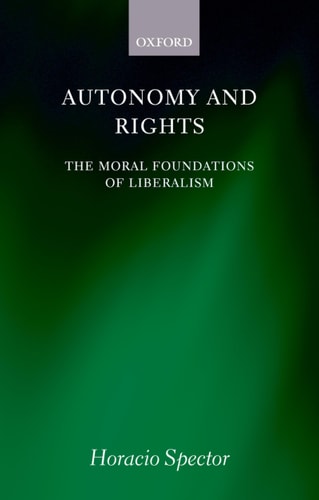
Autonomy and Rights: The Moral Foundations of Liberalism
0
0
As an Amazon Associate and affiliate partner, Menrva Books earns from qualifying purchases. Learn more
Author Description
Moral and political theorists who espouse egalitarianism and Marxism tend to assume that it is extremely hard, if not impossible, to put forward an original and plausible moral justification of classical liberalism. Horacio Spector is concerned to build just such a justification. He reconstructs and then criticizes a familiar approach to the moral foundations of classical liberalism which rests on the maximization of negative freedom, and then frames an alternative theory centered in the obligation to protect positive freedom. In so doing, he parts company not only with utilitarianism and contractarianism, but also with the theory of natural rights. Among the topics he discusses are the concepts of negative and positive freedom, the notion of a moral right, the connection between positive freedom and personal autonomy, the axiological uniqueness of each human being, and the agent-relativity of moral reasons.
Menrva's Summary
THE THESIS
Can a robust and original moral justification for classical liberalism be established that transcends traditional utilitarian or natural rights frameworks? Horacio Spector, a scholar in legal and political philosophy, examines the limitations of existing liberal justifications that rely solely on negative freedom. He proposes an alternative moral foundation rooted in the obligation to protect positive freedom, arguing that this approach better accounts for individual autonomy and the axiological uniqueness of persons.
THE SCOPE MAP
What You Will Find
- A critical reconstruction of classical liberal arguments based on negative freedom maximization.
- A theoretical framework connecting positive freedom to personal autonomy.
- An analysis of the agent-relativity of moral reasons and the value of individual human beings.
- A departure from standard utilitarian, contractarian, and natural rights justifications.
THE AUTHORITY PERSPECTIVE
Scholars in political philosophy recognize this work as a rigorous attempt to reframe the moral underpinnings of liberal thought. Readers frequently note the academic density of the prose, which requires a strong background in ethical theory to fully engage with the author's arguments.
Page Count:
200
Publication Date:
2008-03-15
Publisher:
Oxford University Press
ISBN-10:
0199533628
ISBN-13:
9780199533626
Philosophy
Liberalism
Political Theory
Ethics
Community Tags
Similar Books