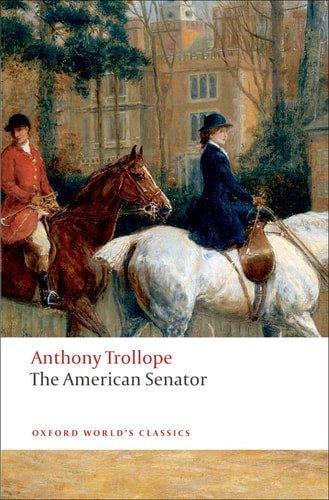
The American Senator
0
0
As an Amazon Associate and affiliate partner, Menrva Books earns from qualifying purchases. Learn more
Author Description
Arabella Trefoil, the beautiful anti-heroine of this novel, inspired Trollope to write of her, "I wished to express the depth of my scorn for women who run down husbands." Arabella's determination to find a rich husband is at the heart of this story and her character, though often maligned, is one of Trollope's most famous and vivid creations.About the Series: For over 100 years Oxford World's Classics has made available the broadest spectrum of literature from around the globe. Each affordable volume reflects Oxford's commitment to scholarship, providing the most accurate text plus a wealth of other valuable features, including expert introductions by leading authorities, voluminous notes to clarify the text, up-to-date bibliographies for further study, and much more.
Menrva's Summary
THE PULSE
The relentless pursuit of a wealthy marriage by the socialite Arabella Trefoil drives the central conflict of this Victorian social satire. Arabella Trefoil navigates the rigid expectations of the British upper class, employing calculated maneuvers to secure a husband despite her lack of fortune. Her objective is constantly challenged by the scrutiny of high society and the shifting loyalties of her potential suitors. The narrative framework utilizes a third-person omniscient perspective to dissect the moral compromises and social pressures inherent in 19th-century courtship rituals.
INSIDE THE PAGES
- Detailed examination of Victorian marriage markets and social mobility
- Sharp satirical commentary on the gender dynamics of the era
- Complex character study of a morally ambiguous female protagonist
- Exploration of the clash between American and British cultural values
- Intricate subplots involving provincial politics and local scandals
- Extensive dialogue that reveals the hypocrisy of the landed gentry
- Pacing that emphasizes the slow accumulation of social consequences
- Focus on the tension between personal ambition and public reputation
THE COLLECTIVE ECHO
Readers frequently highlight the complexity of Arabella Trefoil, noting that she remains one of the most vivid and polarizing figures in the author's body of work. Discussion often centers on the author's ability to balance biting social critique with a nuanced portrayal of a woman constrained by her economic circumstances. Critics often point to the novel's dual focus on the American senator's observations and the domestic machinations of the English characters as a unique structural choice. The pacing is described as deliberate, allowing for a thorough investigation of the social hierarchies that dictate the characters' choices. Many readers appreciate the dry wit and the lack of moralizing, which allows the reader to form their own judgment regarding the protagonist's actions.
Page Count:
566
Publication Date:
2009-03-15
Publisher:
Oxford University Press
ISBN-10:
0199537631
ISBN-13:
9780199537631
Romance
Realism
United States
Victorian
Social Satire
England
classic
Community Tags
Other Editions(10)

Independently Published
2020
Default edition
CreateSpace Independent Publishing Platform
2017

CreateSpace Independent Publishing Platform
2017

Creative Media Partners, LLC
2016

CreateSpace Independent Publishing Platform
2015

Simon & Schuster
2014
CreateSpace Independent Publishing Platform
2013
Oxford University Press
2009

Hard Press
2006
Oxford University Press
1986
Similar Books




Reader Comments
Share Your Thoughts
No comments yet. Be the first to share your thoughts!