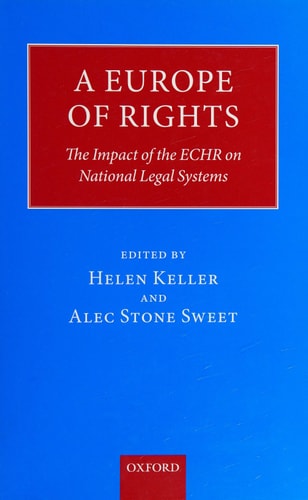
A Europe of Rights: The Impact of the ECHR on National Legal Systems
0
0
As an Amazon Associate and affiliate partner, Menrva Books earns from qualifying purchases. Learn more
Author Description
This volume focuses, comparatively and dynamically, on the reception of the ECHR regime within the national legal orders of the Member States of the Council of Europe. The definition of "legal order" used is expansive, including the legislature, the executive, the judiciary, and any public authority established through constitutional and public law that produces or applies legal norms. The central inquiry of the book is how, through what mechanisms, and to what extent, the national legal orders of the Member States are coordinated with, adapted to, or adjusted by the ECHR - emphasizing both the cooperative and conflictive aspects of reception.The book brings together a series of structured-focused comparisons: each chapter undertaking a comparative case study which collects and analyzes basic data on the reception of the ECHR within national legal orders. These structured-focused comparisons, whose purpose is not so much to test theory, but to develop appropriate theoretical concepts and to generate hypotheses, work on the assumption that comparing two, relatively like cases offer a better opportunity to build more general theoretical frameworks.Through an examination of a set of general questions about how national decision-makers - governments, legislators, and judges - have reacted to the evolution of European human rights law, the chapters enquire how various actors within national legal orders could take decisions to either hinder or to enhance the status of the ECHR. What interests or values, individual or corporate, are judges maximizing? How has this affected the evolution of the ECHR? How do national constitutions take into account treaty law (or international law generally)? Do separation of powers doctrines (or other explicit provisions of public law) permit or prohibit the judicial review of the legal validity of legislative and executive acts with reference to "higher" norms? To what extent should the federal or unitary nature of a Member State make a difference to reception? That is, should we expect the territorial distribution of powers and competences - judicial, legislative, administrative - to have an effect on the status or effectiveness of the ECHR, and if so, how?
Menrva's Summary
THE THESIS
This volume investigates how the European Convention on Human Rights (ECHR) regime is received, adapted, and integrated into the national legal orders of Council of Europe Member States. Authors Alec Stone-Sweet and Helen Keller utilize a comparative framework to examine the interaction between international human rights law and domestic legislative, executive, and judicial systems. By analyzing how national actors respond to the evolution of European human rights standards, the authors develop theoretical concepts regarding the coordination and conflict inherent in supranational legal integration.
THE SCOPE MAP
What You Will Find
- Comparative case studies of ECHR reception across diverse European national legal systems.
- Analysis of the mechanisms used by national judges, legislators, and governments to either hinder or enhance treaty compliance.
- Examination of separation of powers doctrines and their impact on the judicial review of international norms.
- Theoretical frameworks for understanding the cooperative and conflictive dynamics between domestic constitutional law and international treaty obligations.
THE AUTHORITY PERSPECTIVE
Legal scholars and practitioners frequently cite this work as a foundational text for understanding the practical application of the ECHR within domestic jurisdictions. Experts highlight the book's structured-focused comparative methodology as a primary resource for students and researchers analyzing the intersection of national sovereignty and international human rights law.
Page Count:
300
Publication Date:
2008-09-15
Publisher:
Oxford University Press
ISBN-10:
0199535264
ISBN-13:
9780199535262
Law
Human rights
Constitutional Law
International Law
Community Tags
Similar Books













Reader Comments
Share Your Thoughts
No comments yet. Be the first to share your thoughts!