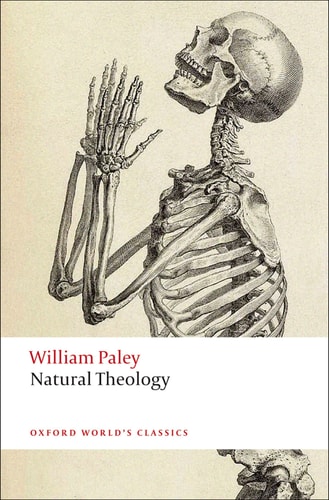
Natural Theology
0
0
As an Amazon Associate and affiliate partner, Menrva Books earns from qualifying purchases. Learn more
Author Description
In Natural Theology, William Paley set out to prove the existence of God from the evidence of the beauty and order of the natural world. Famously beginning by comparing the world to a watch, whose design is self-evident, he goes on to provide examples from biology, anatomy, and astronomy in order to demonstrate the intricacy and ingenuity of design that could only come from a wise and benevolent deity. This new edition, which coincides with the bicentennial of Paley's death, reprints the original text of 1802, which was very influential in its day, and still controversial in ours as we see a resurgence in the debate between"intelligent design" and "creationism." The introduction explains how the book built on the early modern natural theology tradition and why it was so influential. The book also contains two appendixes on Paley's courses, an extended bibliography, and full notes offering further background on the key figures of the day.About the Series: For over 100 years Oxford World's Classics has made available the broadest spectrum of literature from around the globe. Each affordable volume reflects Oxford's commitment to scholarship, providing the most accurate text plus a wealth of other valuable features, including expert introductions by leading authorities, voluminous notes to clarify the text, up-to-date bibliographies for further study, and much more.
Menrva's Summary
THE THESIS
William Paley investigates whether the intricate design of the natural world serves as empirical evidence for the existence of a benevolent creator. Paley, an 18th-century Anglican archdeacon, utilizes the teleological argument to bridge the gap between biological observation and theological conclusion. By systematically examining anatomical and astronomical phenomena, he constructs a framework intended to demonstrate that complex systems necessitate an intelligent designer. His argument relies on the premise that the functional utility of living organisms mirrors the deliberate craftsmanship found in human-made machines.
THE SCOPE MAP
What You Will Find
- The classic watchmaker analogy comparing biological complexity to mechanical design.
- Detailed observations of human anatomy, including the eye and the circulatory system.
- Arguments derived from 18th-century natural history and Newtonian physics.
- A foundational exploration of the teleological argument within the context of Enlightenment-era natural theology.
THE AUTHORITY PERSPECTIVE
Scholars and historians of science recognize this work as a pivotal text in the history of natural theology and its subsequent influence on evolutionary discourse. Readers frequently note the accessibility of Paley's prose, though they acknowledge that the arguments are now primarily studied for their historical significance rather than their contemporary scientific validity.
Page Count:
342
Publication Date:
2008-05-15
Publisher:
Oxford University Press
ISBN-10:
0199535752
ISBN-13:
9780199535750
Non-Fiction
Philosophy
Religion
Natural theology
Theology
Science History
Community Tags
Other Editions(10)






Similar Books












Reader Comments
Share Your Thoughts
No comments yet. Be the first to share your thoughts!