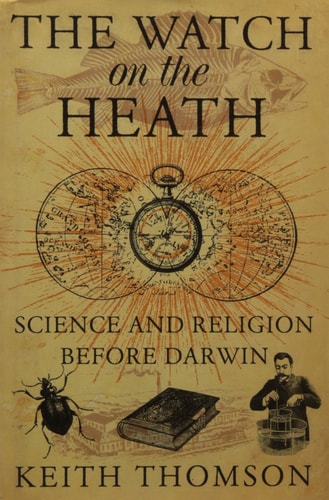
The Watch on the Heath: Science and Religion Before Darwin
0
0
As an Amazon Associate and affiliate partner, Menrva Books earns from qualifying purchases. Learn more
Author Description
Galileo once wrote that 'the Bible tells us how to go to Heaven, but not how the heavens go'. From the Greeks to the present day, thoughtful people have struggled to reconcile the discoveries of science with religious belief and authority. In the age before Darwin many powerful clerics were also notable scientific scholars and leading scientists were often at least conventionally pious. Observing life ever more closely, an extraordinary generation of English geologists, fossil hunters and naturalists were compelled to accept that their planet was older, more complicated, diverse and cruel than they had previously imagined. Questions about God and the Bible inevitably began to arise. But for these men, unlike for Darwin, science and religion could share a philosophical basis: a careful, rational study of nature, instead of denying God, would confirm that life is, after all, the product of God's unique creation. This belief became known as natural theology. Its greatest exponent was William Paley but the work of others such as John Ray, Robert Plot, William Whiston, Thomas Burnet, John Woodward, Erasmus Darwin and countless more writing between 1665 and 1800 gives us an extraordinary glimpse into minds at the forefront of an epic enquiry. Taking his title from Paley's famous analogy that as a watch requiried a maker, so nature in all its intricacy had to be the creation of a supreme designer, Keith Thomson's wonderful book brings to life their dilemmas, and is a winning portrayal of intellectuals struggling with their belief systems in an age of revolutionary science.
Menrva's Summary
THE THESIS
This work investigates how pre-Darwinian naturalists and scholars attempted to reconcile the emerging complexities of scientific discovery with the established tenets of religious faith. Keith Thomson, a biologist and historian of science, examines the intellectual landscape of 17th and 18th-century England, where the study of nature was frequently viewed as a method to confirm divine design. By analyzing the writings of figures such as William Paley, John Ray, and Erasmus Darwin, the author illustrates how these thinkers navigated the tension between empirical observation and theological orthodoxy.
THE SCOPE MAP
What You Will Find
- An examination of the natural theology movement between 1665 and 1800.
- Analysis of the watchmaker analogy and its influence on Enlightenment thought.
- Biographical sketches of key English geologists, fossil hunters, and naturalists.
- A historical framework detailing the shift in understanding regarding the age and complexity of the Earth.
THE AUTHORITY PERSPECTIVE
This text provides a measured and accessible entry point into the intellectual history of natural theology for both students and general readers. The author successfully balances technical scientific context with the philosophical dilemmas faced by early modern thinkers, resulting in a clear and well-documented historical account.
Page Count:
320
Publication Date:
2005-01-01
Publisher:
Harpercollins Reference Hbacks
ISBN-10:
0007133138
ISBN-13:
9780007133130
Religion
Science History
British History
England
Natural theology
Intellectual History
Science and Society
ScienceMathematics
Evolution
Community Tags
Similar Books